When enterprises start their Identity and Access Management (IAM) journey, a common question arises: “How long will this take?”
It’s a valid concern—but rarely has a simple answer.
IAM implementation isn’t plug-and-play. It’s a complex transformation involving systems, processes, data, and people. While some expect quick deployment, IAM timelines vary based on complexity, integration, and readiness.
The key is not just understanding how long IAM takes, but also why it takes that long and how to approach it strategically.
Organizations that set the right expectations early, build a structured roadmap, and leverage modern IAM solutions can significantly accelerate timelines—without compromising quality or scalability.
Explore our IAM Implementation services to simplify integration, accelerate deployment,
and build a scalable identity management framework.
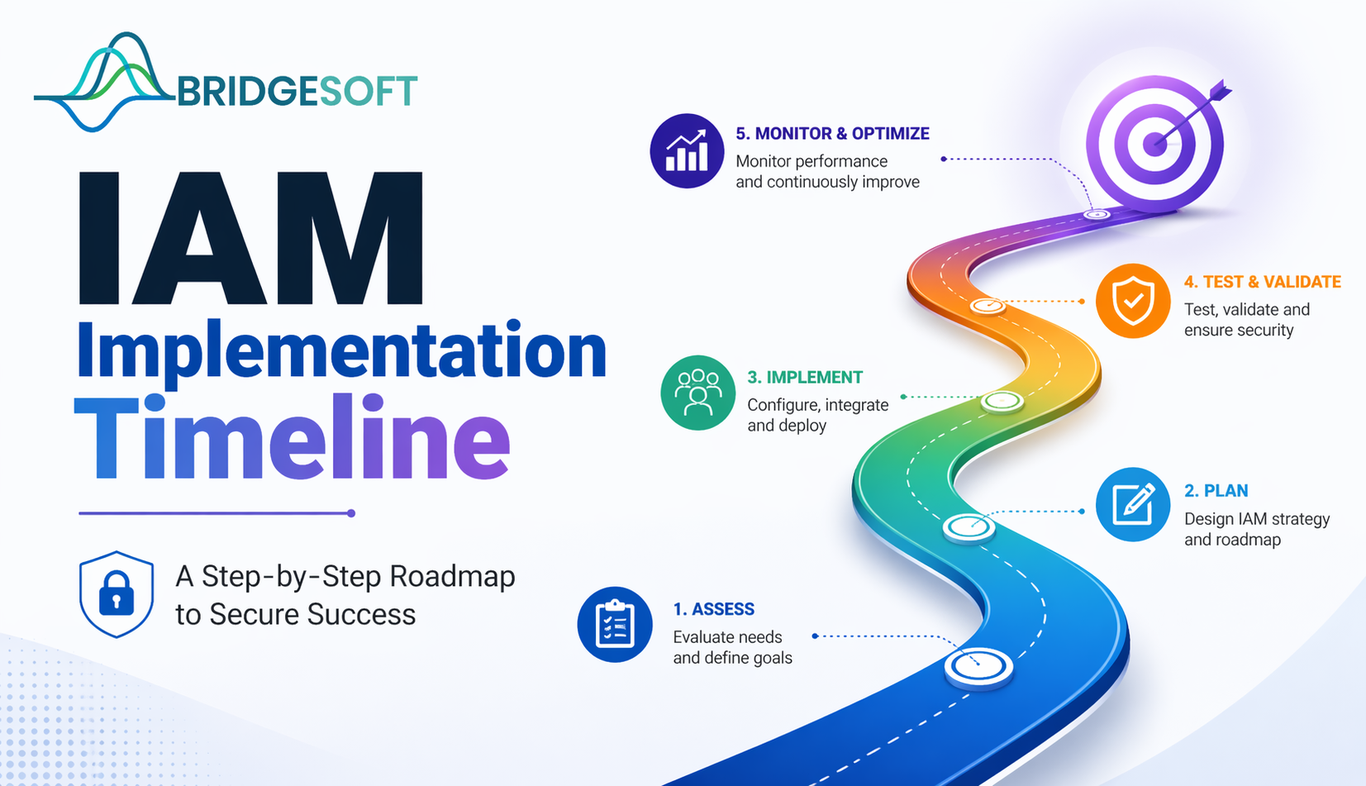
IAM implementation is best viewed as a phased journey rather than a single project. Each phase builds on the previous one, gradually transforming how identities and access are managed across the enterprise.
For most mid-to-large enterprises, IAM implementation can take anywhere from 3 to 12 months, depending on thesystem landscape, legacy dependencies, and scope.
However, timelines are not just influenced by technology—they are shaped by planning, data readiness, and integration strategy. Organisations that invest time upfront in defining their approach often move faster overall.
If you're planning your IAM journey, start with a structured approach, such as building an enterprise roadmap, to gain clarity and avoid delays.
This initial phase evaluates the current IT environment, identity sources, application landscape, and integration readiness to lay a solid foundation for implementation.
Organisations set objectives, prioritise use cases, align teams, and define success metrics to ensure clarity.
This phase may seem preliminary, but it decisively shapes the timeline. Poor planning leads to rework and delays, while a roadmap brings clarity and speeds up later phases.
This phase establishes IAM architecture, identity models, access policies, roles, and governance frameworks.
Teams decide on integration methods, workflow structure, and compliance measures, crafting a clear implementation blueprint.
A key factor influencing timelines here is the level of standardization. Enterprises that rely heavily on custom design often take longer, while those leveraging modern, scalable IAM platforms can significantly reduce design complexity.
This phase implements integration, workflow configuration, provisioning, and access governance setup across applications.
Phase complexity varies with the number, types, and integration readiness of the systems involved.
Organizations that adopt an integration-first approach achieve smoother data flows, faster system onboarding, and reduced manual effort. Leveraging modern IAM solutions—such as low-code or API-driven platforms that can accelerate this phase and minimize reliance on custom development, making future integrations easier.
This is also where early planning pays off. When integration strategies are defined upfront, implementation becomes far more predictable and efficient.
Want to understand where most IAM strategies go wrong?
Explore our detailed breakdown on Why Most IAM Projects Fail.
Testing ensures IAM accuracy, security, and compliance before launch.
This phase validates policies, workflows, integrations, and audit compliance, often through pilot user testing before launch. It is not just a technical exercise—it is a critical step in building confidence across stakeholders and ensuring that the system performs as expected in real-world scenarios.
This phase rolls out IAM capabilities using a staged approach: starting small, then expanding organisation wide.
A gradual rollout reduces risk, drives adoption, and delivers incremental value early.
Change management plays a crucial role during this phase. Clear communication, training, and user support are essential to ensure smooth adoption and long-term success.
While the phases provide a general structure, actual timelines are influenced by several key factors.
Integration complexity is often the biggest variable. Organisations with many legacy systems often experience longer deployment cycles. Similarly, poor identity data quality can introduce delays, as inconsistencies must be resolved before automation can be effective.
Another major factor is the level of customisation. Heavy reliance on custom development increases builds time, testing effort, and long-term maintenance challenges.
Finally, the absence of a phased approach can significantly slow down implementation. Organisations that attempt to deploy IAM across all systems at once often face delays, while those that start small and expand gradually move faster overall.
Speeding up IAM deployment is not about compressing timelines—it’s about removing inefficiencies.
Organizations can accelerate implementation by defining a clear roadmap, prioritizing early integration—which streamlines onboarding of new systems and enhances interoperability—and reducing dependence on custom development. Leveraging modern IAM platforms and IAM implementation services can further simplify deployment and improve scalability.