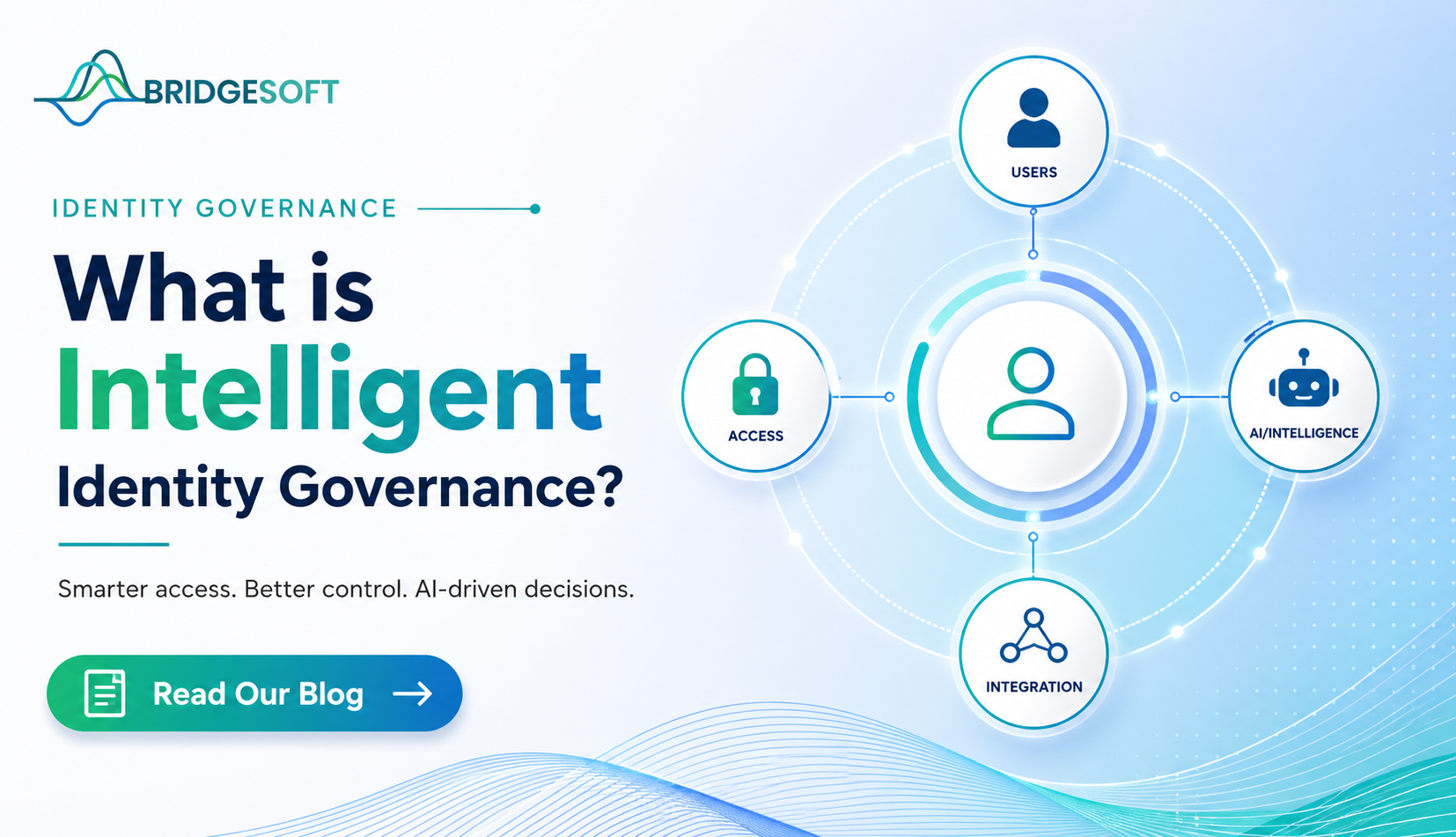
In the modern enterprise, identity has quietly become the most critical layer of security. Firewalls, networks, and endpoints still matter—but increasingly, breaches don’t happen because someone broke in. They happen because someone logged in.
That entity is not always a human user.
It could be an API calling a backend service.
A bot executing a workflow.
An AI agent accessing sensitive data to make decisions.
Enterprises now operate in a dynamic, hyper-connected environment where identity has become universal. In this environment, traditional IAM (Identity and Access Management) struggles to keep pace.
What organizations need today is not just identity management, but Intelligent Identity Governance—a smarter, adaptive, and deeply integrated way to control access across the entire ecosystem. The key benefits include enhanced security by adapting to dynamic threats, improved operational efficiency through automation, and enabling seamless access for users and systems.
Beyond IAM: Why Identity Needs to Become Intelligent
For decades, IAM systems were designed with a straightforward goal: to ensure that users could access the systems they needed to do their jobs. Access was provisioned based on roles, reviewed periodically, and revoked when no longer needed.
This worked well in a relatively stable IT environment.
But today’s enterprises are anything but stable.
Applications span cloud and on premises. Teams are remote and global. Integrations are ongoing. Identities created and modified continuously—often with no human involved—are no longer static.
Traditional IAM systems operate on static rules and periodic checks. But modern enterprises require real-time awareness and continuous decision-making.
This gap marks the emergence of Intelligent Identity Governance—not as a simple upgrade, but as an essential evolution.
Understanding Intelligent Identity Governance
At its core, Intelligent Identity Governance is about bringing context, automation, and intelligence into identity decisions.
It is not just about answering:
Who has access to what?
It is about continuously evaluating:
- Should this access exist right now?
- Is this behavior expected or risky?
- Does this identity still need this level of access?
- Should the system automatically adjust permissions?
In other words, it transforms identity governance from a static control mechanism into a living, adaptive system.
It combines the foundational principles of Identity Governance with:
- AI-driven insights
- Real-time monitoring
- Automated workflows
- Policy-based orchestration
The result: a system that enforces and continuously optimizes access.
The Growing Complexity of Identity in Enterprises
To understand why Intelligent Identity Governance is essential, it’s important to recognize how dramatically the identity landscape has changed.
Enterprises today manage a diverse and expanding set of identities:
- Employees and contractors
- Customers and partners
- APIs and service accounts
- Bots and automation scripts
- AI agents and machine learning models
This diversity introduces major IAM challenges.
There is often no single system that provides complete visibility. Policies are inconsistently applied. Additionally, manual procedures struggle to keep up with the scale.
Over time, this leads to what many organizations experience but struggle to control—identity sprawl.
Access accumulates. Permissions linger. And identities become over-privileged.
Without intelligent governance, this complexity increases enterprise risk.
The Role of an Identity Gateway in Unifying Identity
One of the biggest barriers to effective identity governance is fragmentation.
Most enterprises operate with:
- Multiple IAM tools
- Legacy systems that lack integration
- Cloud applications with separate identity controls
An Identity Gateway is essential in this context.
An Identity Gateway acts as a unifying layer—connecting systems, normalizing identity data, and enabling consistent governance across environments.
It allows organizations to:
- Bridge modern and legacy systems
- Centralize identity visibility
- Standardize access policies
- Enable seamless orchestration of identity workflows.
Without this layer, governance remains fragmented. With it, identity management becomes cohesive and controllable.
From Manual Control to Intelligent Automation
One of the defining characteristics of Intelligent Identity Governance is automation—but not just any automation.
This is intelligent automation.
Traditional IAM automates tasks such as provisioning and password resets. Intelligent systems go further by automating decisions.
They can:
- Automatically provision access based on role and context
- Trigger deprovisioning when risk is detected.
- Recommend access changes based on usage patterns.
- Prioritize high-risk access reviews.
- Detect anomalies in real time.
This reduces reliance on manual intervention while increasing both speed and accuracy.
Organizations can proactively prevent issues rather than just respond to them.
The Power of AI in Identity Governance
Artificial Intelligence plays a central role in making identity governance truly intelligent.
In complex environments, humans can’t analyze every access pattern or detect every anomaly manually. AI fills this gap by continuously analyzing behavior and identifying risks.
It enables:
- Behavioral analysis to detect unusual activity.
- Risk scoring to prioritize critical access decisions.
- Adaptive authentication based on context.
- Role mining and optimization to reduce access complexity.
Perhaps most importantly, AI brings predictive capability.
Instead of asking:
What went wrong?
Organizations can start asking:
What could go wrong, and how can we avoid it?
Continuous Compliance in a Real-Time World
Compliance has traditionally been a periodic activity—prepare for audits, gather evidence, and demonstrate controls.
But in today’s regulatory environment, this approach is no longer sufficient.
Organizations are expected to maintain continuous compliance.
Intelligent Identity Governance enables this by:
- Maintaining real-time audit trails
- Automating evidence collection
- Running continuous access certifications
- Providing instant reporting
This shifts compliance from a reactive burden to a built-in capability, helping organizations reduce audit overhead and ensure ongoing regulatory readiness.
Identity as a Strategic Enabler
When implemented effectively, Intelligent Identity Governance does more than reduce risk—it enables more secure innovation, agility, and operational efficiency across the business.
It allows organizations to:
- Accelerate digital transformation initiatives.
- Onboard applications faster
- Enable secure innovation with AI.
- Improve user experience with seamless access.
Instead of slowing the business down, identity becomes a foundation for growth, increased productivity, and secure digital initiatives.
The Future of Identity: Orchestrated, Intelligent, Unified
The future of identity is not about managing users—it’s about orchestrating an entire ecosystem of identities.
This includes:
- Humans
- Machines
- AI agents
All interacting across systems, continuously.
To manage this complexity, enterprises need a platform that:
- Unifies identity governance
- Automates lifecycle and access decisions
- Applies policies consistently
- Adapts in real time
This is the essence of Intelligent Identity Governance.
Moving Forward with Bridgesoft Identity Gateway
Modern identity challenges require modern solutions.
Bridgesoft Identity Gateway is designed to help enterprises transition from fragmented IAM systems to a unified, intelligent identity governance model.
By combining:
- Identity Gateway capabilities
- AI-driven insights
- Automated lifecycle management
- Seamless integration across environments
…it enables organizations to take full control of their identity ecosystem—securely, efficiently, and at scale.
Discover how Intelligent Identity Governance can transform your
enterprise security and access management.
Book a Free Demo
#IdentityGovernance #IAM #IdentityAccessManagement #IdentityGateway #CyberSecurity #AI #DigitalTransformation #ZeroTrust #AccessControl #EnterpriseSecurity #MachineIdentity #FutureOfIAM #Bridgesoft