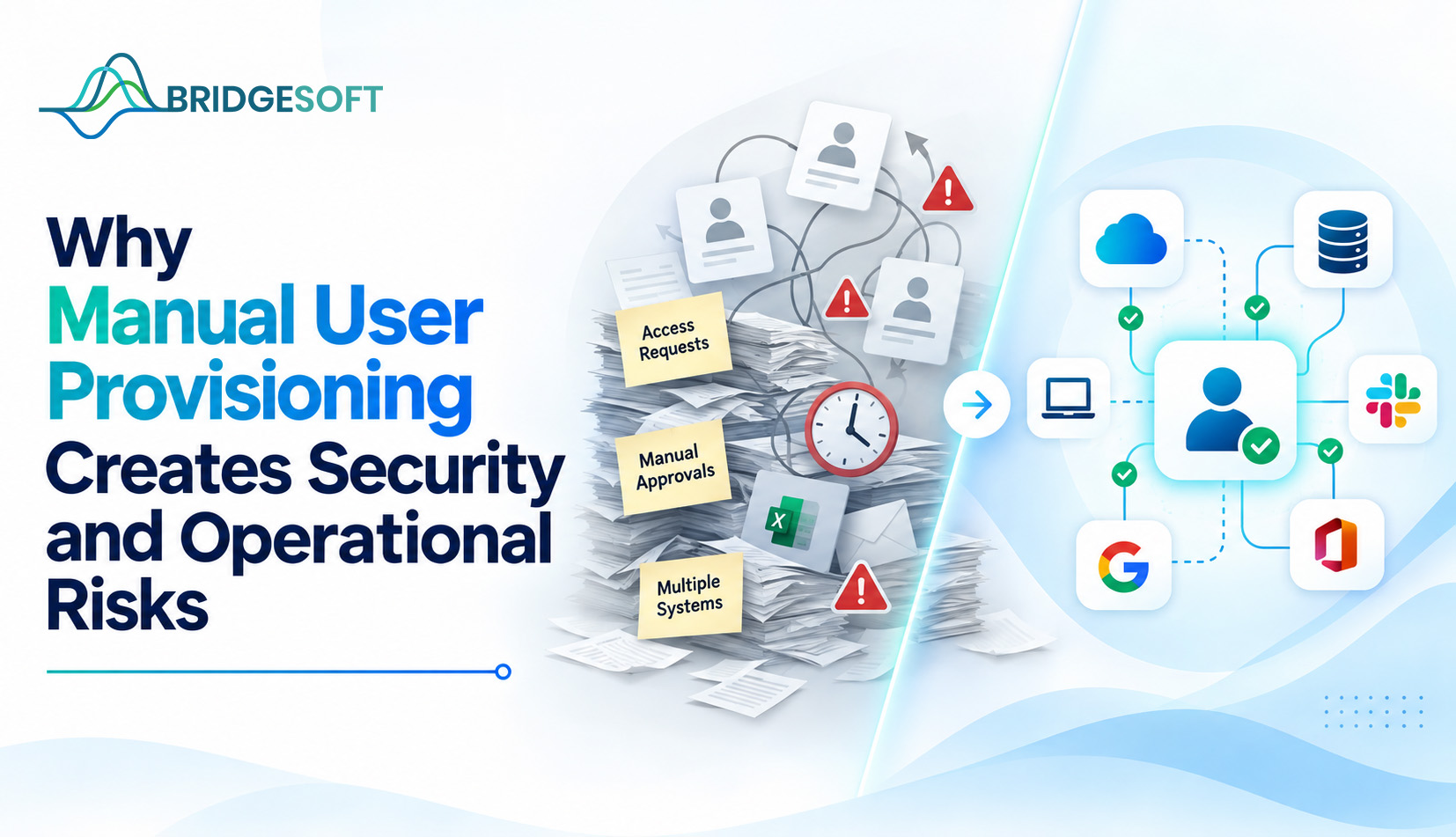
A new hire starts on Monday. By Wednesday, they still can't access the CRM because their access request is sitting in someone's inbox behind forty other tickets. Meanwhile, an employee who left the company three months ago still has an active VPN account nobody remembered to disable. Both problems trace back to the same root cause: provisioning and deprovisioning that depend on someone remembering to do something correctly, every time.
For CIOs, CISOs, and other executives accountable for both security posture and operational efficiency, manual user provisioning isn't just an IT annoyance. It's a recurring source of audit findings, breach exposure, and wasted labor hours that rarely gets budgeted attention until something goes wrong. This article explains why manual provisioning breaks down at scale, where the real risk lives, and what a more governed approach to identity looks like in practice.
Manual provisioning is the process of granting, modifying, or revoking a user's access to systems and applications through direct human action an IT admin creating an Active Directory account, a manager emailing a request to enable a SaaS license. This helpdesk ticket triggers someone to click through five different admin consoles.
No single automated workflow connects the moment someone joins, changes roles, or leaves the organization to the systems that enforce their access. Every step depends on a person noticing the change, interpreting the correct access level, and executing it correctly across every affected system.
This matters because the number of systems a typical mid-sized or enterprise organization runs has grown considerably. A single employee may need accounts in a dozen or more applications: email, CRM, ERP, file storage, VPN, industry-specific software, collaboration tools. Manual provisioning that might have worked reasonably well with five core systems starts breaking down once that number climbs into the double digits.
The core issue isn't that manual processes are always executed badly. It's that they're inconsistent, and inconsistency at scale is where security incidents originate.
Orphaned accounts: When someone leaves a company, deprovisioning must happen across every system they accessed, not just the primary directory. If offboarding relies on a checklist someone works through manually, systems get missed. Former employees, contractors, and vendors with lingering credentials are a well-documented entry point for unauthorized access, because nobody is actively monitoring an account that IT forgot to close.
Access creep: Employees change roles far more often than most access reviews account for. Someone moves from finance to operations and keeps their old permissions because nobody revoked them, only added the new ones. Over a few years, without a structured review process, employees accumulate access rights that far exceed what their current role requires. This is sometimes called privilege creep, and it directly violates the principle of least privilege that most security frameworks and auditors expect organizations to follow.
Inconsistent enforcement of policy: If one admin provisions according to a documented standard and another admin provisions based on what "seems right," the organization ends up with access rights that don't map cleanly to job function. That inconsistency is exactly what auditors’ flag during SOC 2, HIPAA, or ISO 27001 reviews, because it signals the organization can't demonstrate who has access to what, or why.
No reliable audit trail: Manual processes often live in email threads, spreadsheets, and ticket systems that weren't designed to produce a clean, exportable record of every access grant and revocation. When an auditor or incident responder asks, "who approved this access and when," the honest answer is frequently "we'd have to go dig through old tickets."
Security risk gets the headlines, but the operational drag of manual provisioning is just as real and easier for finance leaders to quantify.
IT and helpdesk teams spend a disproportionate share of their time on repetitive access requests work that doesn't require judgment, just execution across multiple systems. That's time not spent on higher-value security work, infrastructure projects, or proactive monitoring that reduces risk.
Slow provisioning also costs the business: new hires who can't be productive in their first week, sales reps who miss deals because they can't access the tools they need, and contractors whose engagements stall while access requests sit in a queue. None of this shows up as a security incident, but it's a direct, recurring drag on productivity that compounds across every hire, role change, and offboarding event.
Identity governance addresses this by replacing ad hoc, person-dependent provisioning with defined policies, roles, and automated workflows that determine access based on role, department, and business rules consistently, every time, with a record of what happened and why.
This typically includes: