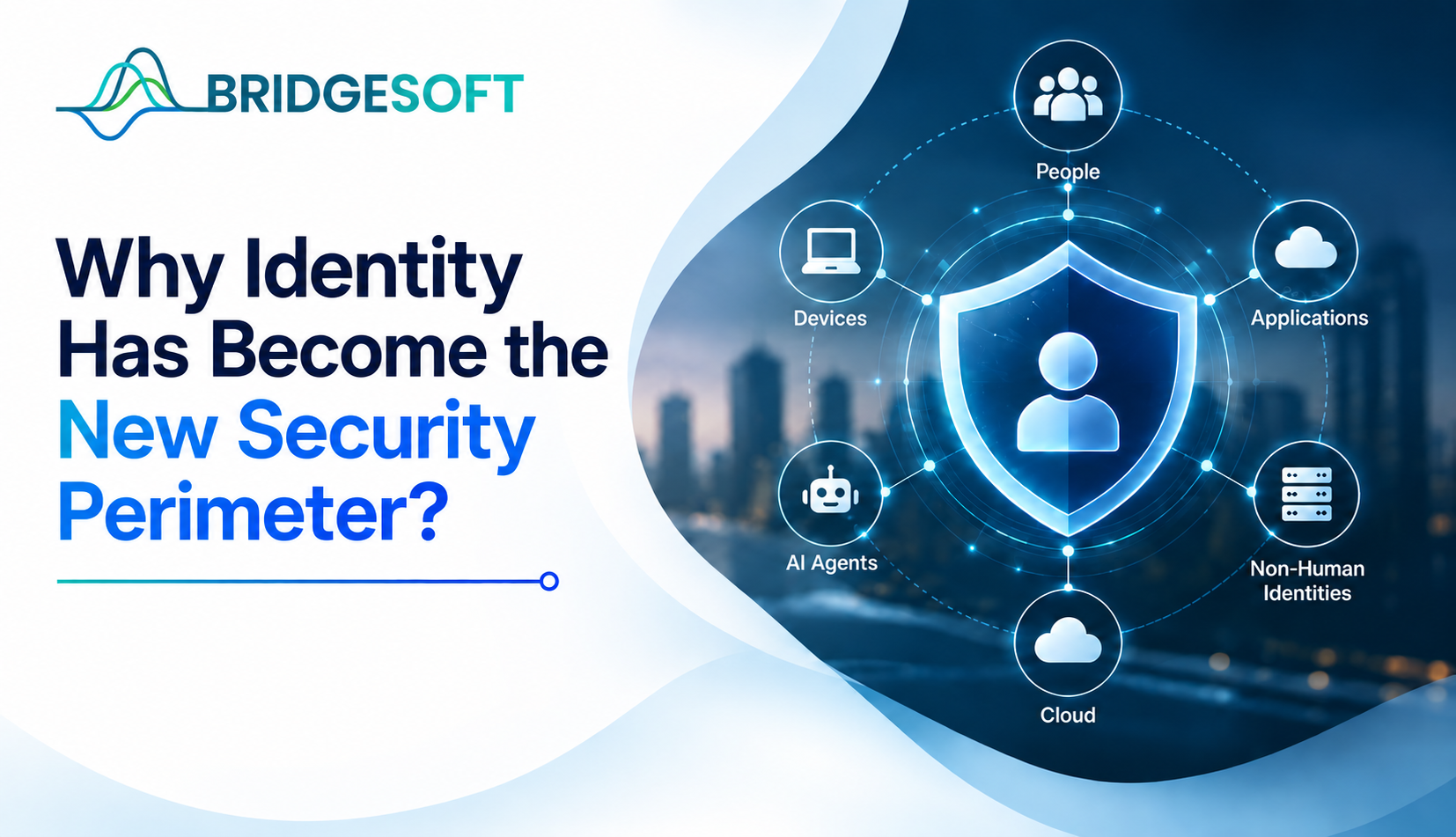
A firewall can protect a network boundary. But what happens when employees work from home, applications run across multiple clouds, contractors need temporary access, and software and AI agents automatically interact with business systems?
The traditional network perimeter becomes much harder to define.
That is why identity has become a central security control point. Modern enterprises increasingly need to determine not simply whether a connection comes from a trusted network, but who or what is requesting access, what it can access, and whether that access is appropriate at that moment.
This is closely aligned with the principles of Zero Trust Architecture (ZTA). NIST's guidance explicitly shifts security away from static network boundaries toward users, assets, and resources, with authentication and authorization performed before access is established.
For CIOs, CISOs, CTOs, and other executives, the implication is straightforward: Identity and Access Management (IAM) is no longer only an IT administration function. It is becoming part of the organization's broader security and risk strategy.
The traditional security model largely assumed that systems inside the corporate network could be trusted more than systems outside it.
That assumption is increasingly difficult to maintain.
Cloud applications, SaaS platforms, remote work, third-party access, APIs, mobile devices, and distributed infrastructure have blurred the boundary between "inside" and "outside."
Identity provides a more useful control point.
An identity can represent an employee, contractor, administrator, application, service account, API, or other non-human entity. IAM determines how those identities authenticate and what resources they can access. Identity governance adds another layer by asking whether that access is appropriate, approved, monitored, and periodically reviewed.
NIST describes this shift as moving from network-centric controls to protecting individual resources, without automatically trusting users or devices based solely on their network location.
Consider a financial services company with employees using Microsoft 365, cloud infrastructure, SaaS applications, and legacy internal applications.
A user may connect from a corporate office in the morning, a home network in the afternoon, and a mobile device while traveling.
The IP address changes. The network changes. The device may change.
But the business still needs to answer the same questions:
This is where IAM becomes strategically important.
Identity controls can follow the user, application, or service rather than depending entirely on a fixed network boundary.
One common misconception is that IAM means usernames, passwords, and single sign-on.
Authentication is important, but it is only one part of the problem.
A mature IAM program typically addresses identity lifecycle management, authentication, authorization, provisioning, deprovisioning, access reviews, privileged access, policy enforcement, and governance.
For example, when an employee moves from finance to procurement, the organization should not simply create a new account. It should determine which existing permissions to remove, which new permissions are required, and whether sensitive access needs additional approval.
That is an identity governance problem.
Similarly, when an employee leaves, turning off the primary login is not necessarily enough. Organizations must consider application accounts, privileged access, service relationships, and other credentials tied to that identity.
The objective is not merely to create identities. It is to maintain appropriate access throughout the identity lifecycle.
The identity perimeter is also expanding because enterprises no longer manage only human identities.
Applications use service accounts. APIs authenticate to other systems. Automated workflows access databases. Cloud workloads communicate with services. AI agents are increasingly being designed to perform tasks and interact with enterprise resources.
NIST's cloud native Zero Trust guidance specifically recognizes the importance of application and service identities alongside human identities.
This creates a difficult governance question:
If an automated identity can access a sensitive business resource, who owns it, what permissions does it have, and when should those permissions expire?
Treating these identities as an afterthought can create significant blind spots.
Identity governance connects security controls with business accountability.
For executives, the important question is not simply whether IAM technology has been deployed. It is whether the organization can demonstrate appropriate access.
A strong identity governance program should help answer:
1. Who has access?
2. What do they have access to?
3. Why do they have it?
4. Who approved it?
5. Is the access still required?
6. What happens when the user's role changes?
7. Can you identify and remove inappropriate access?
This matters for security, operational efficiency, and compliance.
It also matters during audits, mergers and acquisitions, organizational restructuring, and cloud migration, when access relationships can become particularly difficult to understand.