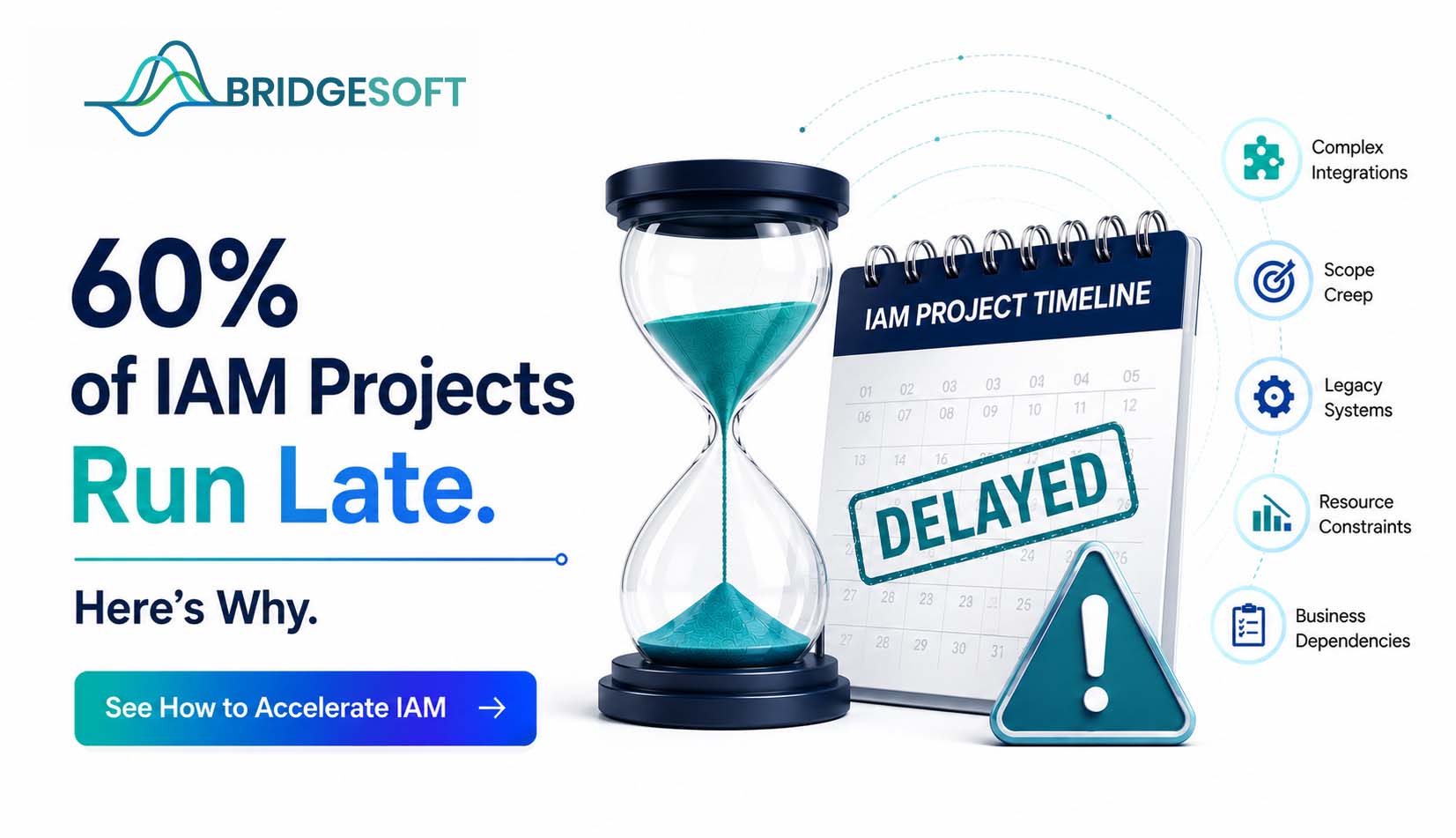
A CISO signs off on a 9-month Identity and Access Management rollout. Six months later, the project team is still reconciling duplicate identities in HR data, legal is asking why contractors weren't scoped into the original access model, and the "go-live" date has quietly moved twice. None of this makes headlines. It just makes budgets tighter and executives more skeptical of the next IT initiative.
This scenario is common enough that it's become close to the norm rather than the exception. Multiple independent studies, from vendor research to academic surveys of IT project failures, put the share of Identity and Access Management (IAM) programs that miss their original timeline, budget, or functional scope at roughly 50% to 70%, depending on how "success" is defined. The exact number varies by source, but the underlying pattern doesn't: IAM projects fail on schedule far more often than comparable enterprise IT initiatives.
That's worth pausing on, because IAM isn't a niche system. It touches every application, every employee and contractor, and, increasingly, every machine identity in the business. When it slips, the cost isn't just a delayed launch date; it's extended security exposure, stalled compliance audits, and a security team stuck running manual workarounds instead of the automated processes the project was supposed to deliver.
IAM is usually sold and scoped as a technology deployment. In practice, it's a business transformation project wearing a technology costume. That mismatch is the root cause behind most delays.
It touches everything, so scope is never really fixed. A CRM rollout affects the sales team. An IAM implementation affects HR onboarding workflows, finance approval chains, IT provisioning, vendor and contractor access, and often OT or physical security systems too. Every one of those groups has its own exceptions and edge cases, and most of them don't surface until integration testing is already underway.
Identity data is rarely as clean as anyone assumes. Duplicate accounts, orphaned access, inconsistent role naming across business units, and HR records that don't match Active Directory are the norm, not the exception, in mid-size and large enterprises. Data cleanup is frequently treated as a side task instead of a formal project phase, which means it eats into implementation time the moment automation testing begins.
Legacy systems don't expose the connectors modern IAM platforms expect. Older ERP systems, homegrown applications, and mainframe-adjacent tools often lack the APIs that make identity synchronization straightforward. That forces custom development mid-project, which is slower to build, harder to test, and more expensive to maintain once it's live.
Governance decisions are deferred rather than decided up front. Questions like who approves access requests, how roles are defined, and who owns exceptions are business decisions, not technical ones. When they're left for "later," later usually arrives in the middle of user acceptance testing, and the project stalls. At the same time, stakeholders argue over decisions that should have been made in week two.
Executive sponsorship fades after kick-off. A well-documented pattern in IT project research is that roughly a third of large IT projects lose momentum because senior leadership disengages after initial approval and requirements shift mid-project, with no one empowered to say no. IAM, because it cuts across departments, is unusually vulnerable to this.
Most IAM content stops at "legacy integration is hard" and "governance matters," without explaining what changes the outcome. Two things consistently separate the projects that hit their date from the ones that don't:
A Practical Framework for Staying on Schedule
| Phase | What Often Goes Wrong | What Keeps It on Track |
| Discovery & data audit | Treated as a quick checklist item | Dedicated phase with its own sign-off before design begins |
| Governance design | Deferred to "figure out later" | Roles, approvers, and exceptions agreed on paper before build |
| Integration | Legacy systems assumed to be API-ready | Legacy connectivity assessed and piloted before full build |
| Stakeholder alignment | HR, security, and business units looped in ad hoc | Formal charter with named owners from day one |
| Rollout | Big-bang launch across the whole org | Phased rollout by department, application, HR-system scope, or region, with checkpoints |
Enterprises that treat IAM as a phased program typically take 3 to 12 months, depending on system complexity and the extent of custom development required to meet their timelines, far better than those that treat it as a single monolithic project with a single end date.
Bridgesoft works with organizations across banking, healthcare, government, aviation, and energy on Identity and Access Management and Identity Governance implementations, and the projects that stay on schedule are consistently the ones where data readiness and governance decisions are treated as formal, resourced phases rather than assumptions baked into a Gantt chart. That's the structure Bridgesoft builds into enterprise IAM roadmaps before any platform configuration begins.

Bridgesoft helps organizations improve identity visibility, strengthen Identity Governance, streamline Identity Access Management, and modernize identity processes across complex enterprise environments.
Book a Free DemoIAM projects don't usually fail because the technology doesn't work. They run over the timeline because data readiness and governance decisions are treated as afterthoughts rather than as formal phases with real owners and real deadlines. Organizations that build those steps into the plan from day one is the ones that hit their go-live date and keep the resulting system delivering value, rather than becoming another compliance workaround.
If your organization is scoping an IAM or Identity Governance initiative, Bridgesoft can help you build a realistic roadmap before implementation begins. Talk to our team about what a phased approach would look like for your environment.