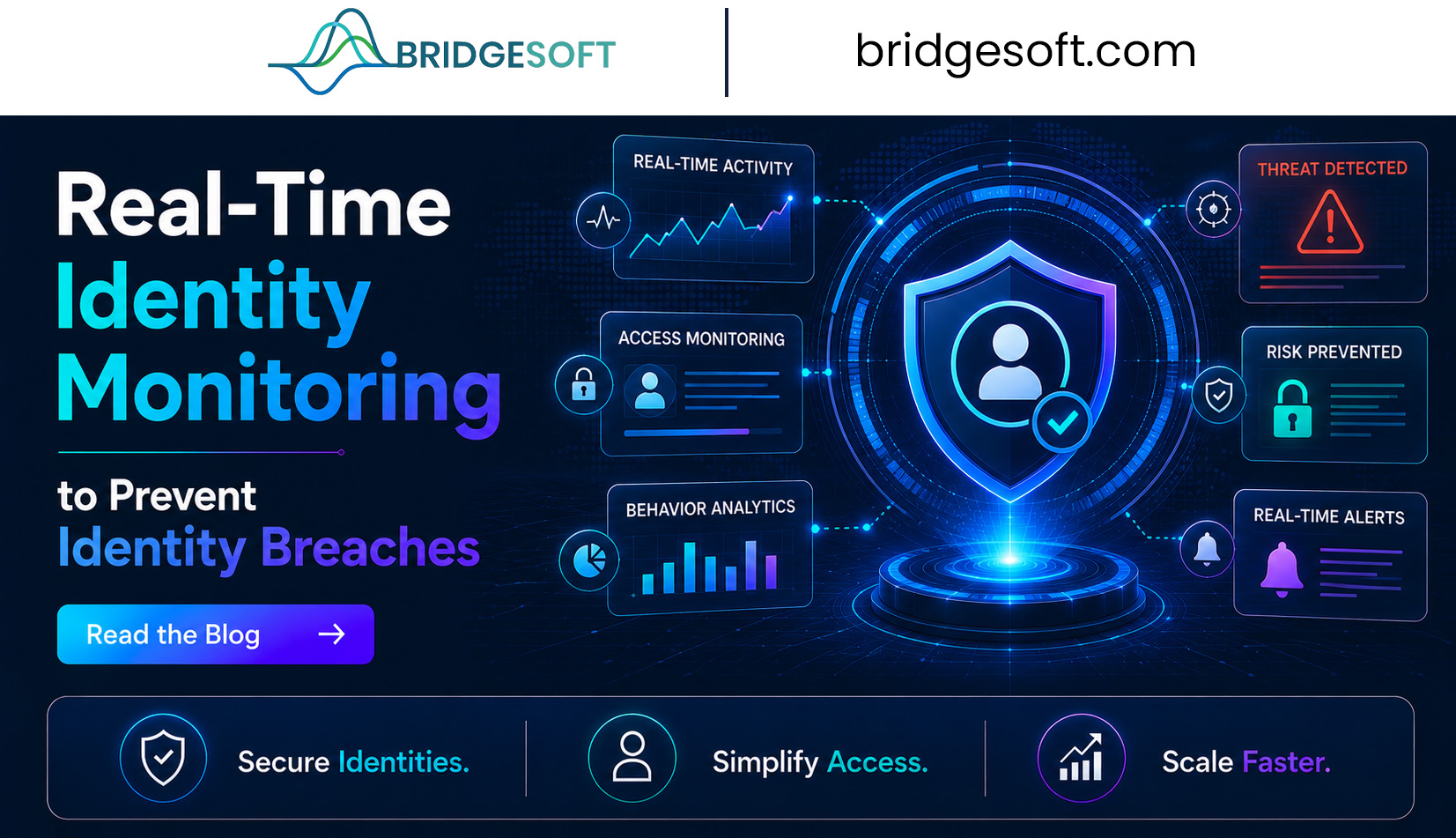
Cybersecurity has entered a new era where identities—not networks—have become the primary target for attackers. Modern enterprises no longer operate within clearly defined network boundaries. AI-driven systems constantly access company resources, employees work remotely, apps operate across several cloud platforms, and third-party integrations are typical.
In this rapidly evolving digital landscape, simply authenticating users is no longer enough. Organizations must continuously verify, monitor, and analyze identity activities in real time.
This is where Real-Time Identity Monitoring becomes a game-changer.
Instead of reacting to security incidents after they occur, organizations can detect suspicious identity behavior as it happens, allowing security teams to respond before attackers gain access to critical systems or sensitive data.
As identity-related attacks continue to rise, real-time monitoring is no longer an advanced security feature—it has become a business necessity.
Most modern cyberattacks no longer begin with malware or network exploits. They begin with compromised identities.
Attackers target stolen credentials, privileged accounts, API keys, service accounts, and cloud identities because they provide legitimate pathways into enterprise environments. Once inside, attackers often move laterally, escalate privileges, and access sensitive information without immediately triggering traditional security controls.
The challenge is that many organizations only validate identities during login. After authentication, user activity often goes largely unmonitored.
This creates a dangerous security gap.
An account may be legitimate at login but become compromised minutes later through credential theft, session hijacking, or insider misuse. These risks may go unnoticed until serious harm has already been done if they are not always visible.
Real-time identity monitoring closes this gap by continuously analyzing identity behavior throughout every session.
Real-Time Identity Monitoring is the continuous observation and analysis of identity activities across users, applications, cloud environments, machine identities, and privileged accounts.
Rather than relying on periodic audits or static access reviews, organizations gain ongoing visibility into how identities interact with enterprise resources.
Modern monitoring systems constantly assess elements like:
By monitoring identities continuously, organizations can identify suspicious activities before they develop into security incidents.
Identity security becomes proactive rather than reactive.
[AI Agents Need Identities Securing Autonomous]
Enterprise environments are constantly changing.
Employees switch devices, access applications from different locations, connect through cloud platforms, and collaborate across multiple business systems. AI agents and machine identities operate continuously in the background, often interacting with sensitive data.
Static security policies cannot keep pace with this level of activity.
Continuous monitoring enables organizations to identify unusual behavior, including:
Detecting these events in real time significantly reduces the opportunity for attackers to move undetected across the environment.
Effective Identity Access Management (IAM) provides the foundation that makes real-time identity monitoring possible.
A centralized IAM platform enables organizations to authenticate users, manage identities, enforce access policies, and maintain visibility across cloud, on-premises, and hybrid environments.
When integrated with continuous monitoring capabilities, Identity Access Management allows organizations to:
Rather than simply controlling access, IAM becomes an intelligent security platform capable of protecting identities throughout their entire lifecycle.
While Identity Access Management controls access, Identity Governance ensures that access remains appropriate over time.
Governance enables organizations to continuously review permissions, validate business justification, and identify excessive or outdated access rights.
When combined with real-time monitoring, Identity Governance enables organizations to answer critical questions:
Continuous governance reduces insider threats, strengthens compliance, and improves accountability across the enterprise.
As organizations move applications and workloads to the cloud, protecting cloud identities becomes increasingly important.
Strong Cloud IAM Security ensures that users, applications, APIs, and machine identities access cloud resources securely while maintaining centralized visibility.
Real-time monitoring extends these protections by identifying suspicious cloud activities immediately rather than after periodic reviews.
Organizations can quickly detect unauthorized access attempts, abnormal privilege usage, compromised service accounts, or unusual API behavior before sensitive cloud resources are exposed.
Cloud adoption has expanded the identity attack surface, making continuous identity monitoring a critical component of enterprise security.