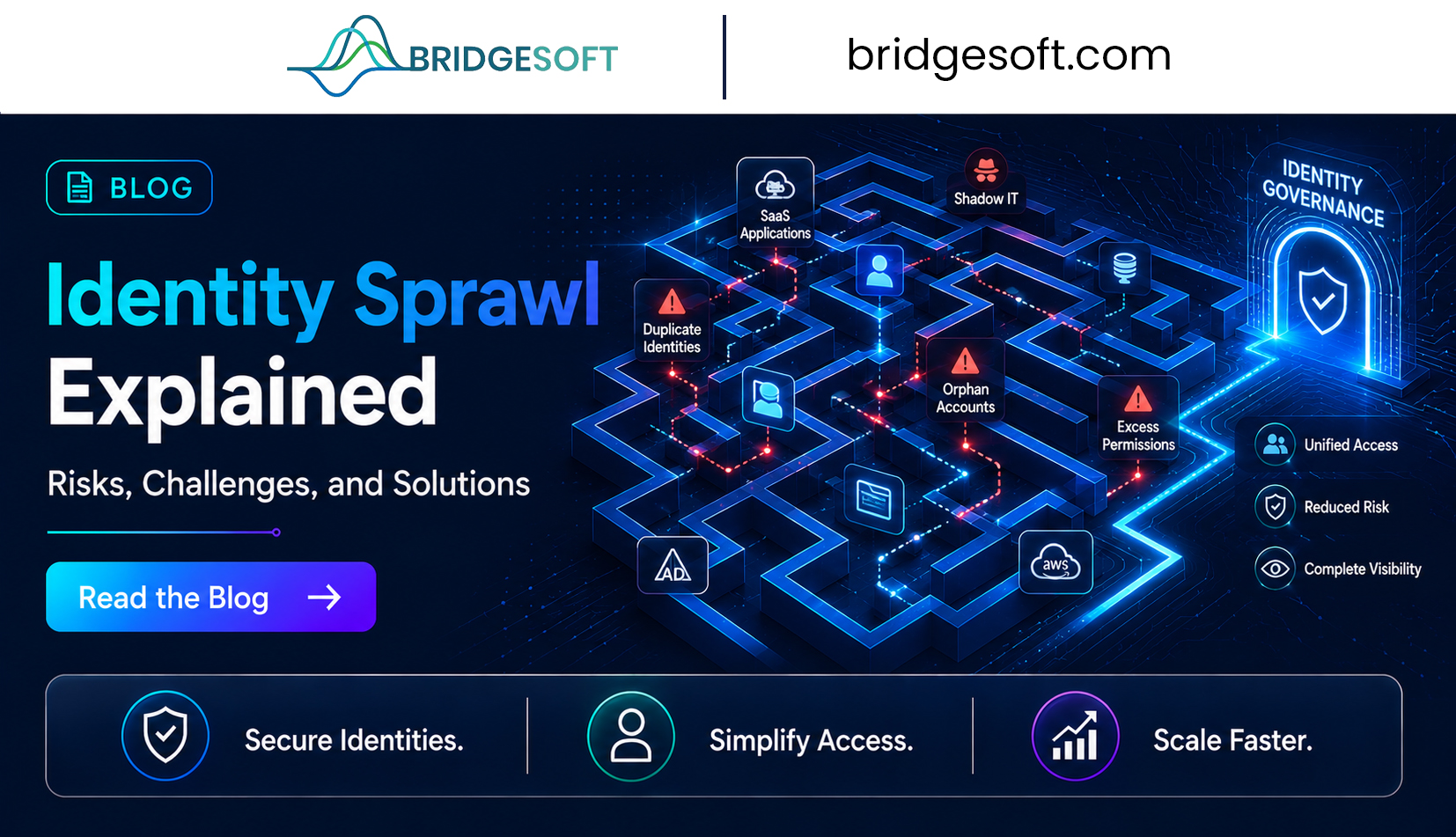
Imagine walking into an office building where no one knows exactly who has access to which rooms. Some employees still carry keys from previous departments, former contractors can enter restricted areas, and duplicate access cards exist without anyone realizing it. The result would be confusion, security risks, and a lack of accountability.
This scenario mirrors what many organizations experience today in their digital environments through a growing challenge known as Identity Sprawl.
As businesses adopt cloud applications, remote work models, third-party integrations, and digital transformation initiatives, the number of identities within the enterprise grows rapidly. Employees, contractors, partners, service accounts, applications, and devices all require access to systems and data. Without proper controls, these identities become scattered across multiple platforms, creating a complex web of unmanaged accounts, excessive permissions, and security vulnerabilities.
Identity sprawl is no longer just an IT challenge—it is a business risk that directly impacts security, compliance, and operational efficiency.
Identity sprawl occurs when organizations accumulate many identities across various systems without centralized visibility or governance. As new applications and services are introduced, user accounts are created in multiple locations, often with inconsistent access policies and little ongoing oversight.
Over time, employees change roles, projects evolve, and systems expand. However, access rights are rarely cleaned up at the same pace. Duplicate identities may appear across platforms, users may retain permissions they no longer want, and inactive accounts may remain active.
The result is an identity ecosystem that becomes increasingly difficult to manage, monitor, and secure.
In today's cloud-driven environment, identity sprawl has become one of the most common challenges organizations face in maintaining effective Identity and Access Management practices.
Modern organizations rely on identities to access virtually every business application and resource. As a result, identities have become one of the most attractive targets for cybercriminals.
Every unmanaged account, unused credential, or excessive permission creates a potential pathway for unauthorized access. If an attacker can compromise a valid identity, they no longer need to overcome conventional network security.
Identity sprawl increases the likelihood of:
The larger the identity ecosystem becomes, the more difficult it is for security teams to maintain control and enforce consistent security policies.
Organizations often discover these risks only after a security event or compliance audit if they don't have an organized identity management strategy.
Beyond security concerns, identity sprawl creates significant operational challenges.
IT teams frequently spend valuable time managing access requests, resetting passwords, reviewing permissions, and tracking down account ownership. As organizations grow, these manual processes become increasingly difficult to scale.
Separate identity stores and applications may be used by different departments, resulting in separation and uneven access control. Mergers, acquisitions, and digital transformation projects often introduce additional complexity by bringing new systems and user populations into the environment.
Without centralized visibility, organizations struggle to answer fundamental questions:
These challenges can quickly overwhelm security and IT teams, increasing both risk and administrative costs.
One of the most effective ways to combat identity sprawl is through strong Identity Governance.
Identity Governance provides organizations with visibility, accountability, and control over user access across the enterprise. It ensures that identities are continuously monitored, reviewed, and aligned with business requirements.
With proper governance processes in place, organizations can:
Identity Governance transforms access management from a reactive process into a proactive security strategy. Instead of simply granting access, organizations can continuously evaluate whether access remains appropriate.
This level of oversight is essential for maintaining security in increasingly complex digital environments.
As identity ecosystems grow, organizations must ensure users have access only to the resources required for their roles.
This is where Secure Access Management becomes critical.
Secure Access Management focuses on enforcing access controls that protect sensitive systems while maintaining a seamless user experience. Through centralized authentication, policy enforcement, and risk-based access decisions, organizations can significantly reduce identity-related threats.
Modern access management solutions provide features such as:
These capabilities help organizations strike the right balance between security and productivity while minimizing opportunities for unauthorized access.
Businesses can reduce their attack surface and improve overall cybersecurity resilience by implementing Secure Access Management procedures.