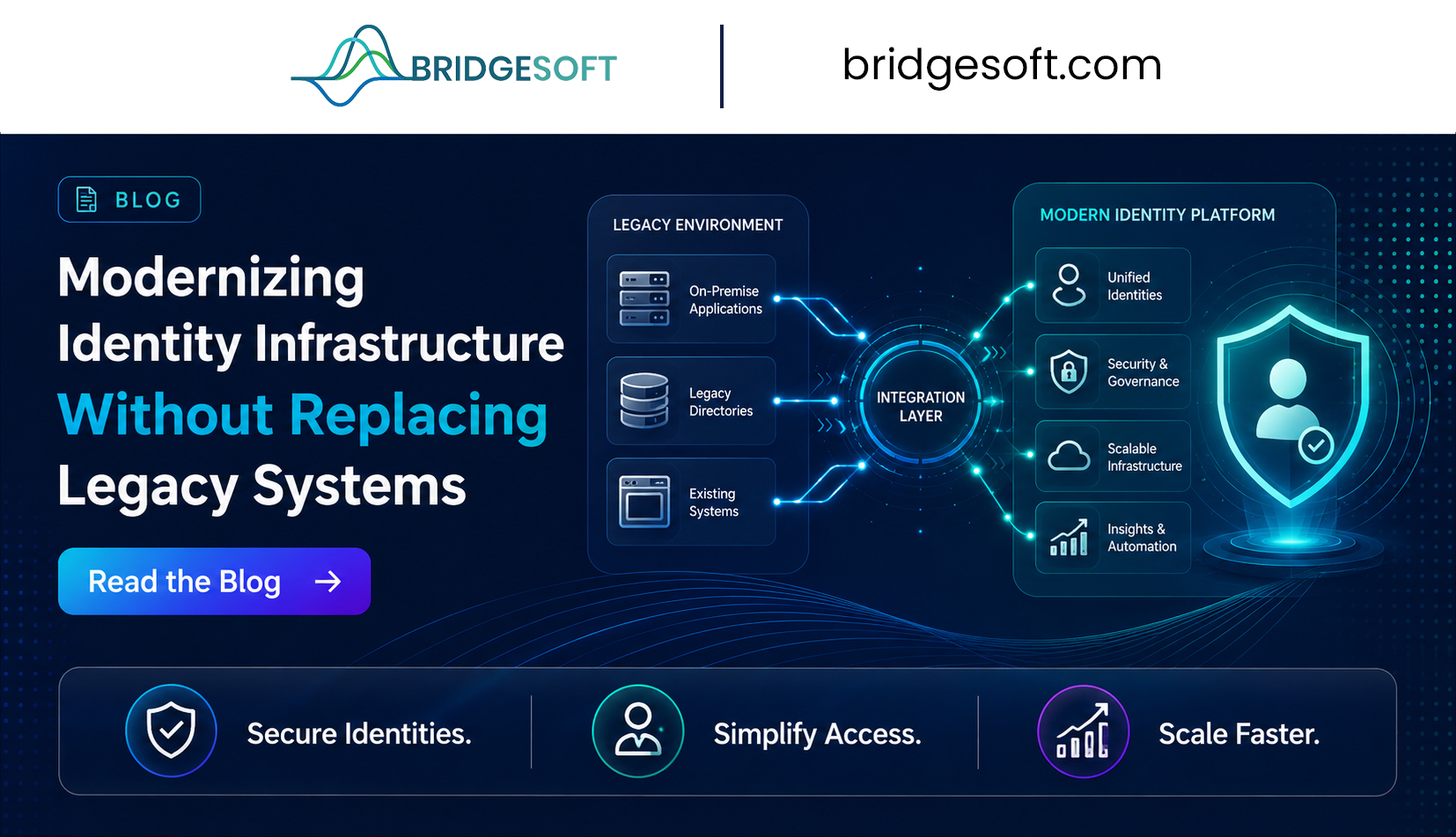
Digital transformation is reshaping organizations as they adopt new technologies. Modern Identity Access Management (IAM) is essential not only for security, compliance, and efficiency, but also for achieving organization-wide visibility, automating processes, and supporting future growth.
Enterprises often need to modernize identity systems but rely on legacy applications with vital data and workflows that cannot be replaced quickly.
Modernizing identity doesn't require replacing legacy systems. Updating identity layers around existing applications enhances security and compliance.
A strategic approach to Identity and Access Management enables enterprises to maintain business continuity while building a secure, scalable, and future-ready identity ecosystem.
Many organizations continue to rely on deeply embedded legacy systems. To carry out crucial business tasks, they use ERP platforms, HR systems, financial applications, and operational databases.
Most legacy applications predate modern cybersecurity requirements and use outdated authentication and limited access controls.
As organizations move to cloud and hybrid environments, legacy limitations create IAM challenges. Security teams lose visibility, struggle to enforce policies, and cannot manage identities across silos.
Replacing every legacy app is rarely practical due to cost, risk, and dependencies. Instead, adopt strategies that add modern identity to your current infrastructure.
Complete technology overhauls bring high costs, long timelines, and major disruptions.
Legacy applications support mission-critical processes, making replacement disruptive and complex.
Modernizing identity strengthens security while core applications remain untouched, avoiding disruption.
A full system update is more time-consuming and riskier than IAM modernization.
One of the most effective modernization strategies is to create a centralized identity layer that connects both modern and legacy applications.
This identity layer centralizes authentication, authorization, governance, and lifecycle management, allowing enterprise-wide automation and control.
A modern IAM Strategy enables organizations to:
Modernize security without altering legacy applications.
Modern Identity Governance helps organizations control access in complex environments.
Without centralized governance, enterprises often struggle to answer fundamental questions:
Who has access to critical systems? Are permissions aligned with job responsibilities? Are inactive accounts still active? Are privileged users properly monitored?
Modern identity platforms provide centralized governance capabilities that help organizations enforce access policies consistently across both legacy and modern systems.
Organizations lower the risk of excessive or unauthorized access while increasing visibility, reporting, and access.
As regulatory requirements continue evolving, Identity Governance becomes a critical component of long-term security and compliance strategies.
Modern identity makes Lifecycle Management easy to automate.
Manual identity processes are slow, inconsistent, and error-prone.
Modern IAM Implementation enables organizations to automate identity lifecycle activities across connected systems. When employees join, change roles, or leave the organization, access can be automatically updated in accordance with predefined policies and business rules.
This not only improves operational efficiency but also reduces security risks associated with delayed provisioning or orphaned accounts.
Automation helps organizations maintain consistent access controls while significantly reducing administrative overhead.
Modernizing identity infrastructure introduces integration, model, and dependency issues.
However, these challenges become manageable with a phased IAM Strategy that prioritizes high-risk systems and gradually expands modernization efforts across the enterprise.
Successful organizations typically begin by assessing existing identity environments, identifying governance gaps, and defining clear modernization objectives.
Organizations connect legacy systems to modern platforms using federation, gateways, APIs, and automation.
This phased approach minimizes disruption while delivering measurable security and operational improvements.
Organizations that modernize identity infrastructure while retaining legacy systems gain significant advantages.
Modern IAM improves security and compliance while reducing costs through automation and simpler management.
Above all, they create a scalable identity foundation that facilitates future cloud adoption, digital transformation projects, and changing business needs.
Rather than hindering innovation, legacy systems continue to deliver business value when they operate within a modern identity framework.
You can modernize identity infrastructure by building around existing systems. This approach lets you gain security and efficiency improvements without disruption or high costs.
Focusing on IAM Strategy, Identity Governance, and automated Identity Lifecycle Management allows you to overcome IAM challenges while preserving vital business operations.