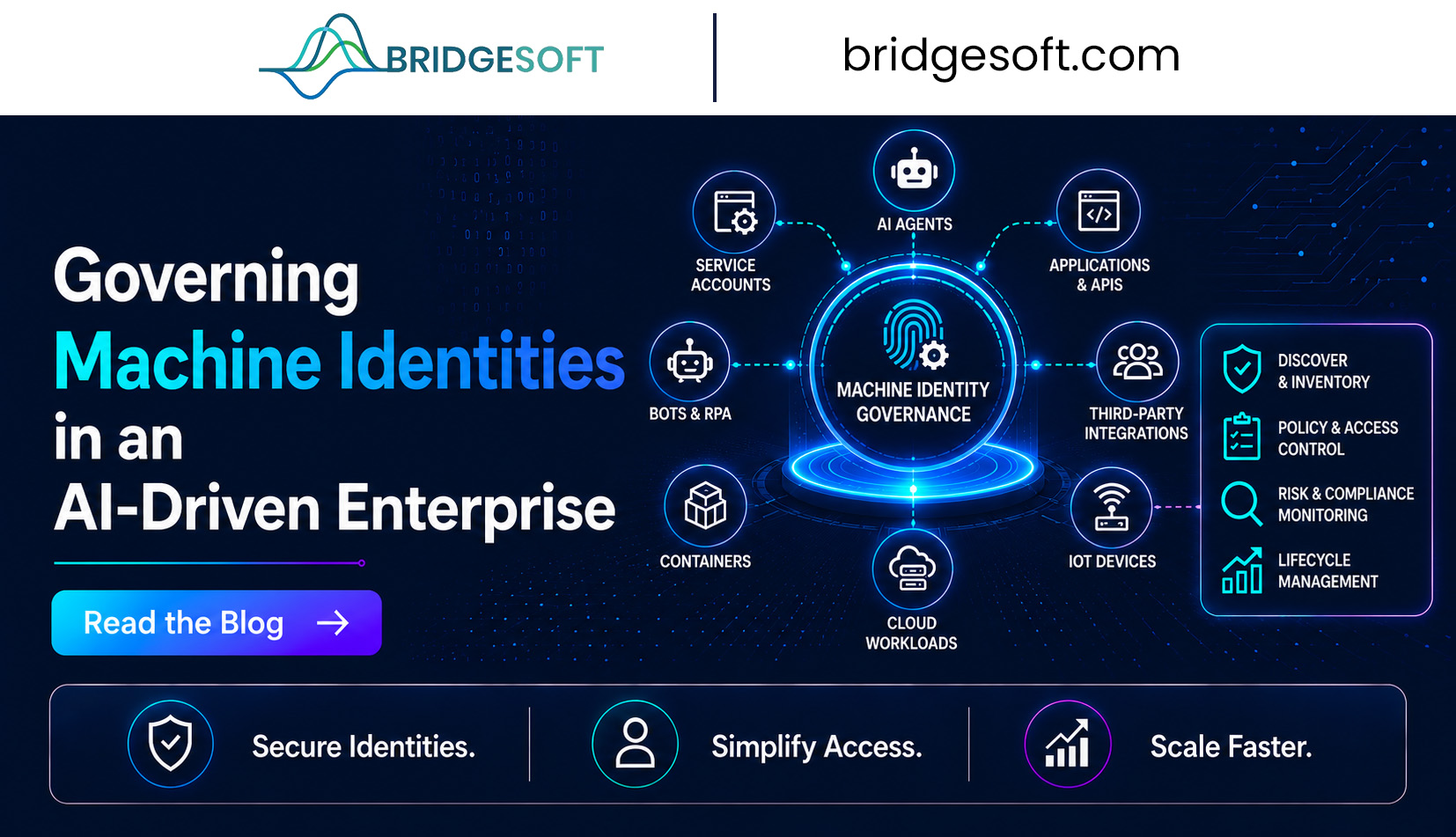
The way businesses operate is changing due to the rapid adoption of artificial intelligence. AI-powered applications, intelligent automation, APIs, cloud-native workloads, robotic process automation (RPA), and software bots are now performing tasks that once required human intervention. As enterprises continue to embrace digital transformation, the number of non-human identities is growing faster than that of traditional user accounts.
Every AI agent, service account, application, API, container, and automated process requires credentials to communicate with systems and access sensitive resources. These machine identities have become essential to modern business operations, yet they often receive far less attention than human users.
The challenge is that machine identities can easily outnumber employees in large enterprises. Without proper controls, they create security blind spots that increase the risk of unauthorized access, credential misuse, and compliance failures.
This is why organizations are expanding Identity Governance beyond human users and adopting governance strategies that include every digital identity operating within the enterprise.
Understanding Machine Identities
Unlike human users, machine identities represent software-based entities that interact with applications, services, and infrastructure. They authenticate to systems, exchange data, execute automated tasks, and support business-critical processes without direct human involvement.
Examples include cloud workloads, APIs, service accounts, AI agents, containers, virtual machines, DevOps pipelines, and automation bots.
Although these identities are not people, they often possess highly privileged access to enterprise systems. In many organizations, machine identities have permission to access sensitive databases, cloud services, financial applications, and business-critical infrastructure.
As AI adoption accelerates, the number of machine identities continues to grow, making governance increasingly important.
Why Conventional Identity Management Is Insufficient
Most organizations have invested significantly in securing employee identities through modern Identity Access Management solutions. Processes such as onboarding, access reviews, authentication, and role management are well established for human users.
Machine identities, however, often fall outside these governance processes.
Service accounts may remain active for years without review. API credentials are frequently shared across applications. Secrets and certificates may not be rotated regularly, while AI-driven workloads often receive broad permissions to avoid operational disruption.
These practices increase security risk and make it difficult to maintain visibility across enterprise environments.
As organizations become increasingly dependent on automation and AI, machine identities must be governed with the same discipline applied to human users.
The Risks of Unmanaged Machine Identities
Every unmanaged identity creates potential security exposure.
Machine identities frequently possess elevated privileges because they perform critical business operations. If compromised, they can provide attackers with direct access to sensitive applications, cloud resources, and enterprise data.
Another challenge is visibility. Many organizations cannot accurately identify how many machine identities exist, who owns them, what systems they access, or whether their credentials remain active.
Without centralized governance, organizations risk:
As machine identities continue to multiply across hybrid and cloud environments, these risks become increasingly difficult to manage manually.
The Role of Identity Governance
Modern Identity Governance provides organizations with the visibility and control required to manage both human and machine identities consistently.
Instead of treating machine identities as technical assets, organizations should manage them throughout their lifecycle—from creation and authorization to credential rotation, monitoring, and retirement.
Governance policies should answer critical questions such as:
Who owns each machine's identity? What systems can it access? Does it still require those permissions? When were credentials last rotated? Is the identity still actively being used?
Establishing clear ownership and continuous monitoring helps reduce security risks while improving operational accountability.
Building Identity Governance into IAM Implementation
Successful IAM Implementation should include machine identities from the very beginning rather than treating them as an afterthought.
As organizations deploy new identity platforms, governance policies should extend beyond employees and contractors to include applications, APIs, bots, cloud services, and AI workloads.
A comprehensive Identity Access Management strategy should automate machine identity creation, enforce least-privilege access, monitor credential usage, and support regular access reviews.
Integrating machine identities into existing IAM processes enables organizations to maintain consistent security policies across all identity types.