In today’s rapidly evolving digital landscape, organizations manage more identities, applications, devices, and access requests than ever before. The rise of cloud computing, remote work, SaaS adoption, and digital transformation initiatives has significantly increased the complexity of securing enterprise environments.
Traditional security models, built on static rules and manual processes, struggle to keep pace with modern threats. Cybercriminals continue to increase their sophistication. Identity is currently the primary attack vector, and security teams are continually trying to strike a balance between security and user experience.
This transformative shift is being driven by Artificial Intelligence (AI).
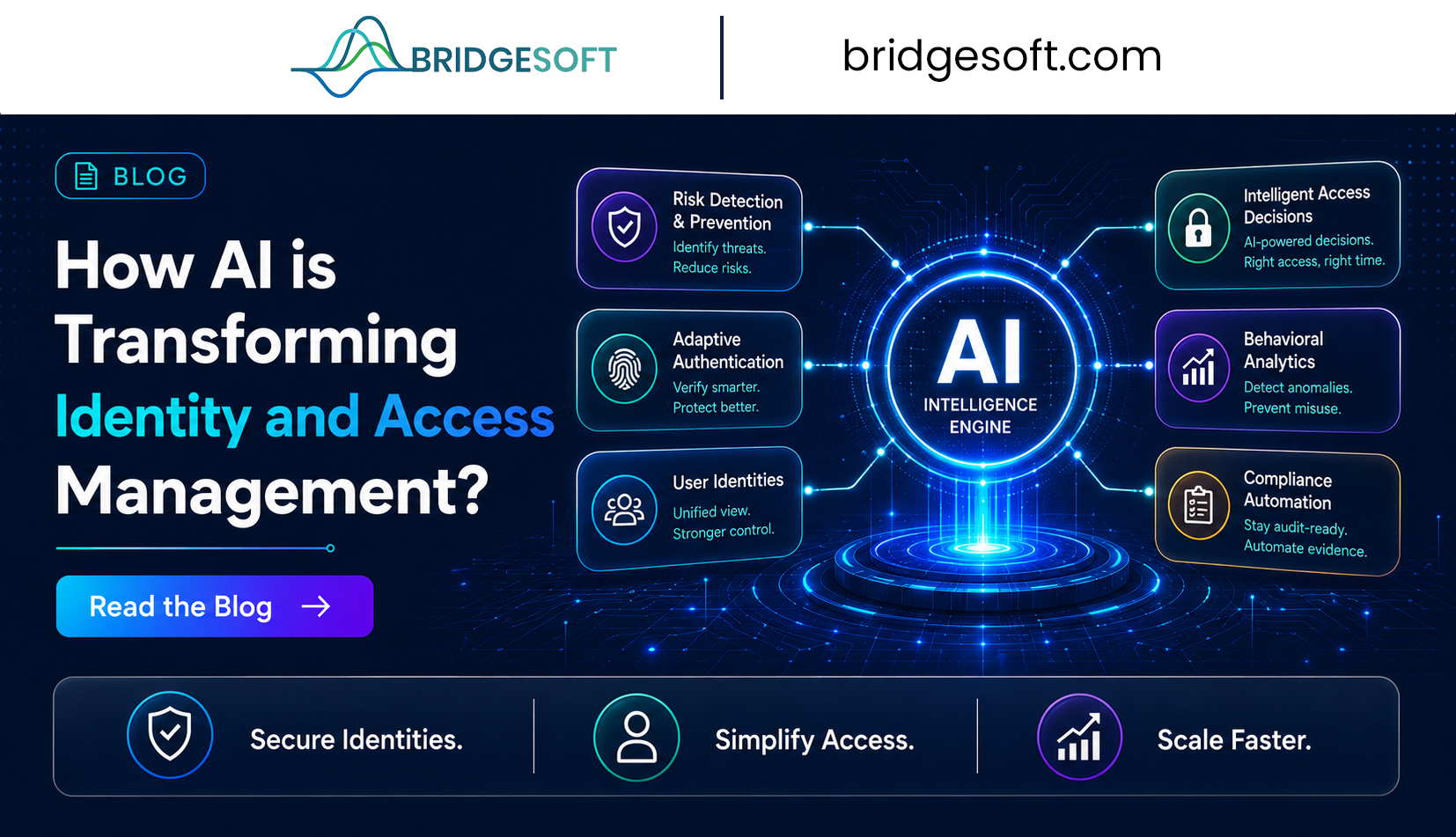
AI brings intelligence, automation, and predictive capabilities to Identity and Access Management (IAM). It helps organizations secure identities, automate routine tasks, detect threats quickly, and speed up deployment.
As businesses continue to modernize their security frameworks, AI-powered IAM solutions become essential for building resilient, scalable, and future-ready identity ecosystems.
Modern organizations manage thousands of employees, contractors, partners, customers, applications, and devices across cloud, on-premises, and hybrid environments. Users now expect seamless access from any location and device.
Traditional IAM systems often use predefined policies and require manual oversight. While these approaches served organizations well in the past, they no longer address today’s dynamic threat landscape.
Security teams face increasing challenges, such as:
To address these challenges, organizations increasingly integrate AI into their Identity Access Management strategies.
How AI Benefits Identity Access Management
Through intelligent decision-making, AI is reshaping every phase of IAM. Automating procedures, enhancing threat detection, boosting Identity Gateway intelligence, and expediting IAM implementation are the four main ways that this change is most noticeable.
One of the most significant advantages of AI in IAM is its ability to automate complex and repetitive identity management tasks.
During IAM Implementation, organizations often spend substantial time managing user onboarding, offboarding, role assignments, access reviews, and policy enforcement. Manual handling of these activities can consume resources and lead to errors.
AI streamlines these operations by analyzing organizational structures, job roles, departments, and historical access patterns to automatically recommend appropriate permissions.
For example, when a new employee joins an organization, AI-powered systems suggest access rights based on similar users within the same department and role. This approach reduces administrative effort and keeps access policies consistent and compliant.
AI also improves governance by identifying:
Organizations may increase operational efficiency, enhance compliance, and greatly lessen the workload for IT and security personnel by automating these procedures.
Modern cyberattacks frequently target user identities and credentials. As a result, organizations need security solutions that detect threats before they escalate into major incidents.
AI enhances Identity Access Management by continuously analyzing user behavior, login patterns, device information, and contextual signals.
Unlike traditional systems that rely solely on predefined rules, AI learns normal user behavior over time and quickly identifies anomalies that may indicate compromised accounts or unauthorized access attempts.
For example, when an employee suddenly attempts to access sensitive resources from an unfamiliar country, on an unusual device, or at an unexpected time of day, AI detects the deviation and triggers additional security measures.
AI adds predictive intelligence to IAM methods, going beyond real-time monitoring to spot new threats before they materialize as security incidents.
AI can detect:
With this proactive approach, security teams can respond faster, cut false positives, and improve cyber resilience.
As identity becomes the new security perimeter, predictive intelligence plays a critical role in every successful IAM strategy.
The Identity Gateway serves as a critical control point between users and enterprise applications. It plays a central role in authentication, authorization, and access enforcement.
AI significantly increases the intelligence of modern Identity Gateway by introducing adaptive access controls and real-time risk assessment.
Rather than applying the same authentication requirements to every user, AI evaluates multiple contextual factors, including:
Based on these insights, the system dynamically adjusts authentication requirements.
For low-risk activities, users enjoy seamless access with minimal friction. For higher-risk situations, the Identity Gateway automatically enforces stronger security measures such as Multi-Factor Authentication (MFA), step-up authentication, or additional verification procedures.
This smart approach provides the best of both worlds:
Digital transformation is reshaping organizations as they adopt new technologies. Modern Identity Access Management (IAM) is essential not only for security, compliance, and efficiency, but also for achieving organization-wide visibility, automating processes, and supporting future growth.
Enterprises often need to modernize identity systems but rely on legacy applications with vital data and workflows that cannot be replaced quickly.
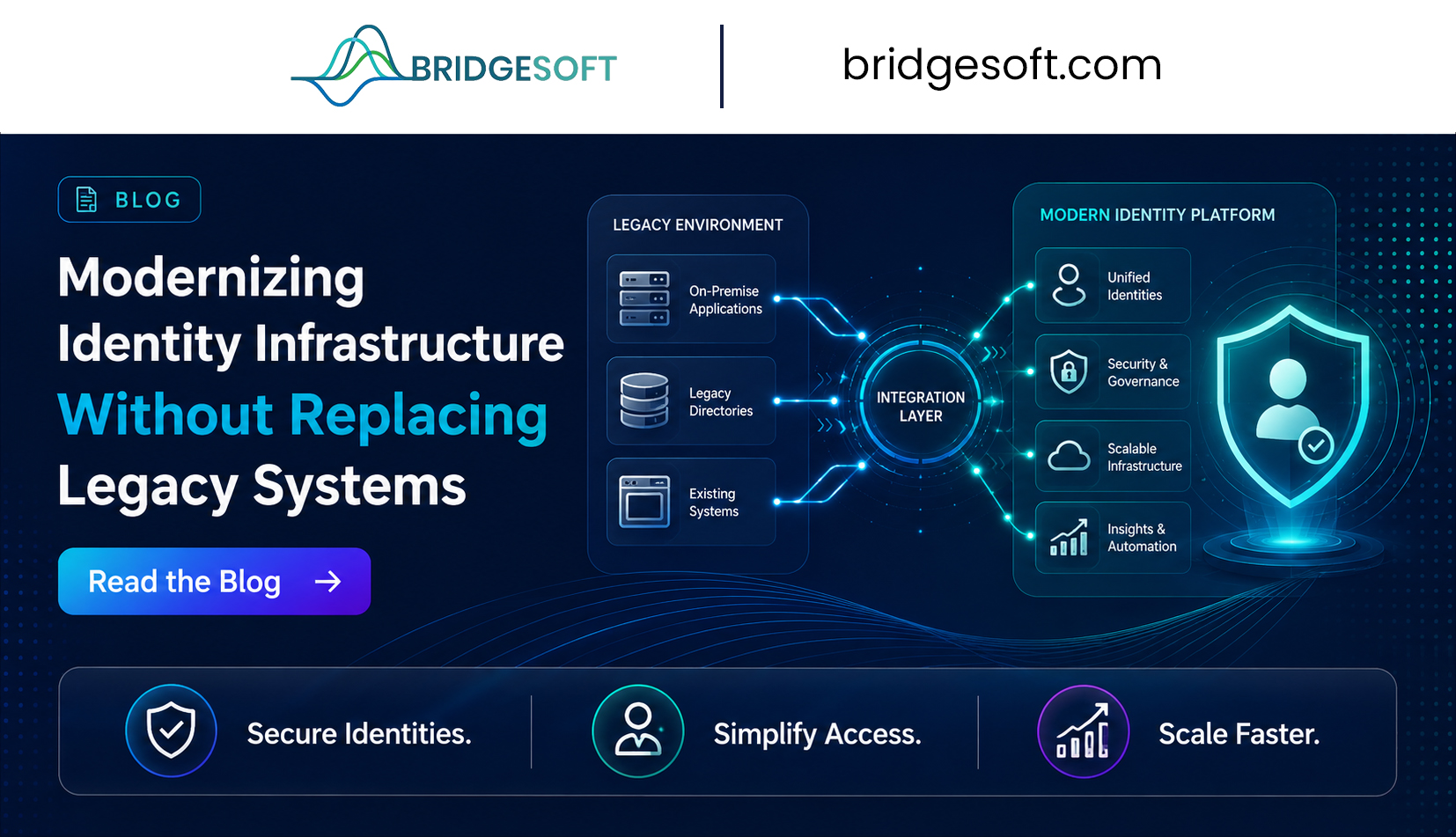
Modernizing identity doesn't require replacing legacy systems. Updating identity layers around existing applications enhances security and compliance.
A strategic approach to Identity and Access Management enables enterprises to maintain business continuity while building a secure, scalable, and future-ready identity ecosystem.
Many organizations continue to rely on deeply embedded legacy systems. To carry out crucial business tasks, they use ERP platforms, HR systems, financial applications, and operational databases.
Most legacy applications predate modern cybersecurity requirements and use outdated authentication and limited access controls.
As organizations move to cloud and hybrid environments, legacy limitations create IAM challenges. Security teams lose visibility, struggle to enforce policies, and cannot manage identities across silos.
Replacing every legacy app is rarely practical due to cost, risk, and dependencies. Instead, adopt strategies that add modern identity to your current infrastructure.
Complete technology overhauls bring high costs, long timelines, and major disruptions.
Legacy applications support mission-critical processes, making replacement disruptive and complex.
Modernizing identity strengthens security while core applications remain untouched, avoiding disruption.
A full system update is more time-consuming and riskier than IAM modernization.
One of the most effective modernization strategies is to create a centralized identity layer that connects both modern and legacy applications.
This identity layer centralizes authentication, authorization, governance, and lifecycle management, allowing enterprise-wide automation and control.
A modern IAM Strategy enables organizations to:
Modernize security without altering legacy applications.
Modern Identity Governance helps organizations control access in complex environments.
Without centralized governance, enterprises often struggle to answer fundamental questions:
Who has access to critical systems? Are permissions aligned with job responsibilities? Are inactive accounts still active? Are privileged users properly monitored?
Modern identity platforms provide centralized governance capabilities that help organizations enforce access policies consistently across both legacy and modern systems.
Organizations lower the risk of excessive or unauthorized access while increasing visibility, reporting, and access.
As regulatory requirements continue evolving, Identity Governance becomes a critical component of long-term security and compliance strategies.
Modern identity makes Lifecycle Management easy to automate.
Manual identity processes are slow, inconsistent, and error-prone.
Modern IAM Implementation enables organizations to automate identity lifecycle activities across connected systems. When employees join, change roles, or leave the organization, access can be automatically updated in accordance with predefined policies and business rules.
This not only improves operational efficiency but also reduces security risks associated with delayed provisioning or orphaned accounts.
Automation helps organizations maintain consistent access controls while significantly reducing administrative overhead.
Modernizing identity infrastructure introduces integration, model, and dependency issues.
However, these challenges become manageable with a phased IAM Strategy that prioritizes high-risk systems and gradually expands modernization efforts across the enterprise.
Successful organizations typically begin by assessing existing identity environments, identifying governance gaps, and defining clear modernization objectives.
Organizations connect legacy systems to modern platforms using federation, gateways, APIs, and automation.
This phased approach minimizes disruption while delivering measurable security and operational improvements.
Organizations that modernize identity infrastructure while retaining legacy systems gain significant advantages.
Modern IAM improves security and compliance while reducing costs through automation and simpler management.
Above all, they create a scalable identity foundation that facilitates future cloud adoption, digital transformation projects, and changing business needs.
Rather than hindering innovation, legacy systems continue to deliver business value when they operate within a modern identity framework.
You can modernize identity infrastructure by building around existing systems. This approach lets you gain security and efficiency improvements without disruption or high costs.
Focusing on IAM Strategy, Identity Governance, and automated Identity Lifecycle Management allows you to overcome IAM challenges while preserving vital business operations.
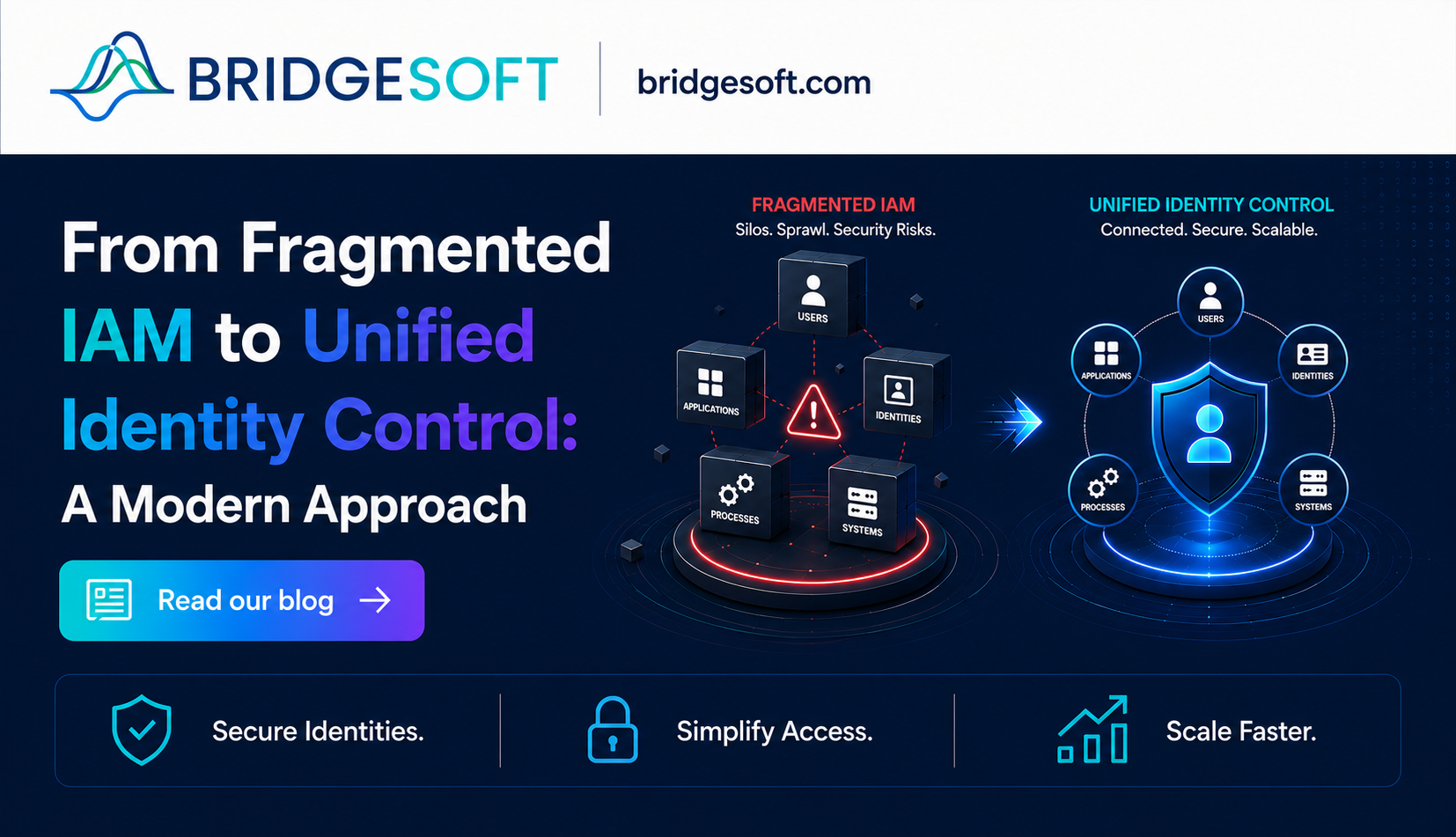
Organizations today operate in highly connected digital environments where employees, applications, and data exist across cloud, on-premises, and hybrid infrastructures. While businesses continue to accelerate their digital transformation, many still struggle with fragmented systems that create security gaps, operational inefficiencies, and inconsistent access controls.
Disconnected platforms and manual access process’s complicate identity management. Employees juggle multiple credentials, and IT teams spend excessive time resolving access issues. These systems decrease productivity and heighten the risks of unauthorized access and compliance failures.
Organizations are moving toward unified identity control—a centralized approach that strengthens security and streamlines access management. Modern IAM solutions create connected ecosystems with improved visibility, governance, and operational efficiency.
Fragmented IAM grows as organizations add technologies, expand operations, acquire new businesses, merge with other entities, or integrate multiple systems—without a centralized identity strategy. Large enterprises with multiple subsidiaries or business units often inherit disconnected identity environments that become increasingly difficult to manage and secure over time.
Without Identity Governance, organizations risk excessive privileges, orphaned accounts, delayed deprovisioning, and inconsistent access policies. These gaps expose systems and data, creating compliance headaches during audits.
In addition, scattered access information makes it difficult for security teams to gain complete visibility into who has access to critical resources and whether those permissions remain appropriate. Modern enterprises require more than isolated identity tools — they need centralized identity intelligence to secure the entire digital ecosystem.
[The Future of Identity Governance]
A unified IAM approach turns identity into a strategic advantage by centralizing authentication, access management, and user governance. Unified Identity and Access Management delivers stronger security, smoother operations, and more consistent controls across the enterprise.
Modern IAM platforms support advanced security capabilities such as Single Sign-On (SSO), Multi-Factor Authentication (MFA), and adaptive authentication. These technologies help employees securely access applications without the complexity of managing multiple credentials. At the same time, organizations strengthen protection against unauthorized access attempts and identity-based cyber threats.
Unified identity systems automate access tasks and centralize operations on a single platform, reducing IT complexity and supporting seamless user experiences across cloud and hybrid environments.
Identity is the new security perimeter. Organizations must monitor access requests, permissions, and identity-related activity to reduce risk and stay compliant. Identity Governance is essential.
Modern governance solutions give visibility into user access across systems. Businesses automate reviews, enforce policies, and monitor activities to spot risky behavior or excessive permissions.
By integrating Identity Governance into a centralized IAM framework, organizations can significantly reduce insider threats, improve compliance readiness, and ensure that users maintain only the access necessary for their roles. Automated audit reporting and policy enforcement also simplify compliance management for regulations such as GDPR, HIPAA, and ISO standards.
Manual identity management causes delays, inconsistencies, and security gaps. Modern IAM platforms automate user access provisioning to fix this.
Intelligent workflows let organizations automatically create accounts, assign permissions, and grant role-based access. When roles change or employees leave, permissions are updated or revoked immediately.
Automated user access provisioning improves operational efficiency while reducing the risks associated with dormant accounts, overprovisioned access, and manual errors. It also enhances employee productivity by enabling faster, more secure access to business-critical applications.
As organizations adopt cloud, remote work, and SaaS applications, digital transformation security becomes a top priority. Modern IAM Solutions provide the scale and flexibility required to secure rapidly evolving environments.
Centralizing identity controls enables consistent security across the enterprise. Adaptive authentication and AI-driven threat detection respond dynamically to changing risk levels and user behaviors.
Unified platforms also accelerate innovation by simplifying integration with digital services, allowing organizations to extend IAM policies consistently across the organization.
Final Thoughts:
Fragmented identity systems add complexity, inefficiency, and security risks that businesses can no longer ignore. Unified IAM centralizes control, strengthens governance, improves secure access management, and automates provisioning.
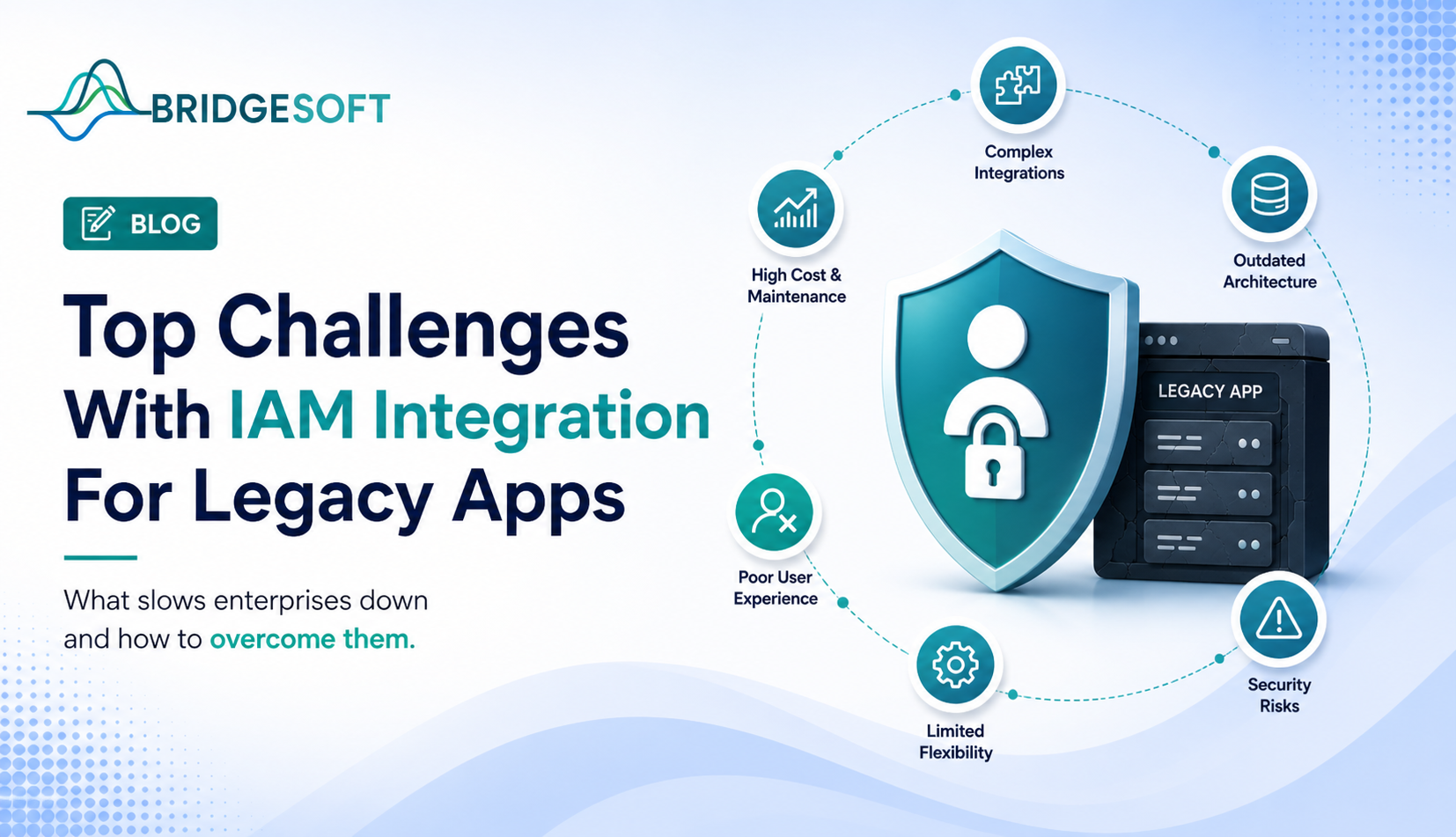
As organizations accelerate digital transformation, Identity Access Management (IAM) has become a critical part of enterprise security. Businesses today must manage secure access across cloud platforms, enterprise applications, hybrid infrastructures, remote workforces, and digital ecosystems. However, many organizations still depend heavily on legacy systems that were never designed to support modern identity requirements.
While these older applications continue to support important business operations, they often create major barriers during IAM implementation. Outdated architectures, fragmented authentication methods, manual processes, and limited cloud compatibility make identity modernization significantly more complex and time-consuming.
Modern enterprises need centralized, scalable, and secure identity environments, but legacy systems often slow down this transformation journey.
Most legacy applications were built long before cloud computing, remote access, and advanced cybersecurity threats became enterprise priorities. As a result, many older systems still rely on outdated authentication models such as local credentials, shared accounts, and disconnected user databases.
These limitations create significant integration challenges when organizations attempt to implement modern Identity Access Management solutions.
Many legacy applications do not support modern authentication protocols like SAML, OAuth, OpenID Connect, or Multi-Factor Authentication (MFA). This forces organizations to build custom integrations, deploy access gateways, or use middleware solutions to connect older systems with centralized IAM platforms.
Legacy environments also tend to store identity information across multiple disconnected systems, making it difficult to establish a unified identity framework. Without centralized visibility, organizations struggle to manage user access, monitor permissions, and automate identity lifecycle processes effectively.
Strong Identity Governance depends on visibility, automation, and consistent policy enforcement. Legacy systems often lack these capabilities, making governance initiatives more difficult to implement.
Organizations operating with outdated infrastructures frequently struggle to answer critical security questions such as:
Without centralized governance, businesses face increased risks related to insider threats, audit failures, compliance violations, and unauthorized access.
Manual access reviews and disconnected reporting processes also increase administrative overhead for IT and security teams.
One of the biggest reasons IAM implementation projects slowdown is the complexity of integrating legacy applications into modern identity ecosystems.
Organizations often face:
Many older systems require extensive customization before they can support centralized authentication or governance workflows. This increases deployment timelines, implementation costs, and operational complexity.
Manual identity management processes further delay modernization efforts. Tasks such as onboarding, offboarding, permission assignments, and approval workflows often rely on manual intervention, making automation more difficult to achieve.
As organizations move toward cloud and hybrid infrastructures, identity security becomes even more important. However, many legacy systems struggle to integrate with modern Cloud IAM Security frameworks.
Older applications often lack support for:
This creates security gaps between on-premises legacy systems and cloud environments.
Without consistent identity policies across systems, organizations increase the risk of credential compromise, unauthorized access, and compliance issues.
Modern IAM implementation strategies must therefore focus on securing both legacy and cloud-based systems through a unified identity framework.
Legacy systems do not only slow down IAM implementation — they also increase long-term operational costs.
Organizations often spend additional time and resources on:
Extended implementation timelines also delay the return on investment for broader digital transformation initiatives.
In many cases, the longer organizations postpone legacy modernization, the more difficult and expensive future IAM projects become.
Although legacy environments present challenges, organizations can modernize identity management successfully through a phased approach.
The first step is conducting a comprehensive identity assessment to understand existing systems, authentication methods, access structures, and governance gaps.
Organizations should prioritize high-risk applications containing sensitive data or privileged accounts and gradually integrate them into centralized IAM workflows.
Modern IAM solutions can support legacy modernization through:
Automation also plays a critical role in accelerating IAM implementation. Automating onboarding, deprovisioning, approvals, and access reviews helps reduce manual effort while improving security consistency.
By adopting phased modernization strategies, businesses can strengthen security while minimizing operational disruption.
In today’s rapidly evolving digital ecosystem, organizations are under constant pressure to modernize their IT infrastructure while maintaining business continuity. Many enterprises rely on legacy systems that power essential operations developed years ago. While these systems provide significant operational value, they often struggle to meet current security expectations, cloud strategies, and compliance requirements. Modern Identity Access Management solutions help organizations overcome these challenges by modernizing security, improving compliance, and supporting continuous operations.
As organizations accelerate digital transformation initiatives, the challenge is no longer just about adopting new technologies. Instead, it is about ensuring seamless integration between existing legacy applications and modern identity platforms. To accomplish this, businesses require secure, scalable, and intelligent identity frameworks that can bridge the gap between traditional infrastructure and modern cloud ecosystems without disrupting ongoing operations.
To address these evolving needs, modern Identity Access Management platforms are designed to provide centralized control, enhanced visibility, and stronger security across hybrid environments. By integrating legacy systems with advanced identity solutions, organizations can create a unified access ecosystem that improves user experience, strengthens compliance, and reduces operational complexity.
Legacy systems often operate in isolated environments with outdated authentication methods, fragmented user directories, and limited support for modern security protocols. While these systems remain essential for many business processes, they can become major obstacles when organizations attempt to implement enterprise-wide digital security strategies.
Traditional systems typically lack advanced Identity Governance capabilities, making it difficult for organizations to monitor who has access to what resources, why that access exists, and whether it still aligns with current business requirements. Over time, unmanaged permissions and excessive access privileges increase security risks and create compliance challenges.
Additionally, legacy applications may not support cloud-native authentication mechanisms such as Single Sign-On (SSO), Multi-Factor Authentication (MFA), or federation standards. This creates fragmented user experiences in which employees manage multiple credentials across disconnected systems, ultimately reducing productivity and increasing the risk of credential misuse.
Modern identity platforms address these challenges by securely connecting old and new technologies. This enables businesses to enhance security, update access management procedures, and comply with new rules without completely redesigning their existing infrastructure.
Organizations today require more than just authentication systems. They need intelligent, policy-driven identity ecosystems that can manage users, applications, devices, and data access in real time. Modern Identity Access Management solutions deliver this flexibility by providing centralized identity controls across on-premises, cloud, and hybrid environments.
By integrating IAM solutions with legacy systems, organizations establish unified access policies, improved governance, and automated provisioning. This approach helps maintain ongoing operations while strengthening security, reducing manual processes, and meeting regulatory requirements.
One of the most critical benefits is the implementation of Role-based access control (RBAC). RBAC allows organizations to assign permissions based on user roles rather than managing access for each employee individually. This not only simplifies administration but also reduces the risk of unauthorized access by ensuring users receive only the permissions necessary for their responsibilities.
For example, employees in finance departments can automatically gain access to financial systems, while HR teams receive permissions aligned with employee management applications. When integrated with legacy systems, RBAC creates a structured and scalable security framework that minimizes manual intervention and reduces administrative overhead.
[What is Intelligent Identity Governance?]
As cyber threats continue to evolve, organizations must move beyond traditional perimeter-based security models. Identity has become the new security perimeter, making Identity Governance a critical component of enterprise cybersecurity strategies.
Modern identity platforms enable organizations to establish governance frameworks that continuously monitor user access, detect anomalies, and enforce compliance policies. Businesses obtain full visibility into their identity ecosystem through automated access assessments, approval workflows, and audit reporting.
When legacy systems are integrated into a centralized Identity Governance framework, organizations can eliminate access silos and create consistent security controls across all applications. This unified visibility helps security teams quickly identify orphaned accounts, excessive permissions, and outdated access rights that could otherwise become potential attack vectors.
Digital transformation is accelerating across industries, but organizations still rely on legacy applications for key business operations. These systems often lack the security features needed for modern cybersecurity and compliance. With cloud adoption, hybrid environments, and remote work, securing legacy applications is now a top IT and security priority.
Modern Identity Access Management (IAM) transforms legacy systems by integrating them into a centralized identity framework. This strengthens security, enhances governance, simplifies access, and supports scalability, bridging traditional infrastructure with future-ready environments without disrupting business operations.
Legacy applications were designed in a different era, before today’s standard cloud computing, security threats, and regulations. Many use outdated authentication, local credential storage, shared admin accounts, and manual processes—creating serious security gaps for modern enterprises.
One of the biggest challenges organizations face with legacy systems is the lack of centralized visibility into identities (knowing who has access to what). Employees often manage multiple usernames and passwords across applications, which increases password fatigue and the risk of credential compromise. In many cases, IT teams struggle to track who has access to specific systems, whether that access is still required, and whether excessive permissions exist within critical applications. Without proper Identity Governance (policies and tools to control user access), organizations lose the ability to effectively control and monitor user access across the enterprise.
Compliance requirements add another layer of complexity. Regulations such as GDPR (General Data Protection Regulation), HIPAA (Health Insurance Portability and Accountability Act), SOX (Sarbanes-Oxley Act), and ISO standards (international security and quality benchmarks) require organizations to implement strict access controls, maintain audit trails, and demonstrate accountability for user permissions. Legacy applications rarely provide these capabilities natively, making IAM implementation essential for organizations that need to meet modern compliance expectations while reducing operational risks.
Modern IAM integrates legacy systems into a unified security framework. Older applications can join a centralized identity environment that supports secure authentication, access control, and automated management—improving security without disrupting operations.
A modern IAM solution centralizes authentication policies, enabling users to securely access multiple systems through Single Sign-On (SSO) and Multi-Factor Authentication (MFA), improving the user experience, security, and operational efficiency.
Identity Governance is increasingly important as organizations grow employees, contractors, vendors, machines, bots, APIs, and AI agents all need secure, controlled access. Without governance, risks like excessive privileges, orphaned accounts, and threats increase.
Integrating Identity Governance into legacy environments improves access visibility, automates reviews, and enforces policy-driven controls. This visibility is vital for compliance and risk management in regulated industries.
Identity Federation
Modern IAM uses multiple methods for integrating legacy applications. Identity federation allows users to authenticate with a centralized provider while accessing older systems, creating a seamless experience while enabling consistent security policies.
Directory Synchronization
Directory synchronization is key for legacy integration. Older systems often rely on on-premises directories like Active Directory or LDAP. Modern IAM can synchronize identities across all environments, improving consistency and reducing administrative effort.
Access Gateway Solutions
IAM access gateways add a security layer in front of legacy applications, allowing modern authentication methods without modifying the applications. Gateways introduce MFA, adaptive authentication, and session policies, even for systems that originally lacked these features.
API-Based Integration
API-based integration lets legacy applications join centralized provisioning, role management, and audit workflows. Automated identity management reduces manual work while improving consistency and security.
Privileged Access Management (PAM)
Privileged Access Management is vital for legacy environments. Many older systems use poorly secured privileged accounts. Integrating PAM secures credentials, automates password rotation, monitors sessions, and enforces least-privilege policies—cutting insider threat risk.
Modern IAM for legacy systems brings more than just security. Automated onboarding and offboarding improve efficiency, unified authentication simplifies user experience, and centralized governance streamlines audits and compliance. A scalable identity foundation supports digital transformation.
Effective IAM implementation needs planning. Legacy setups are complex, with undocumented dependencies and inconsistent models. Organizations must first assess identity structures, application dependencies, privileged accounts, and governance gaps before modernizing.
For years, IAM served as the backbone of enterprise security, ensuring appropriate access for the right people in a world where identities were static and human.
Today, enterprises operate in an ecosystem where AI agents—such as virtual assistants handling HR tasks, autonomous cybersecurity bots, and automated customer support chatbots—act autonomously, APIs communicate continuously, and machines outnumber humans. Identity is no longer a static attribute—it’s dynamic, distributed, and increasingly intelligent.
And in this new reality, traditional IAM isn’t just struggling—it’s fundamentally breaking.
Many organizations believe identity is controlled because users can log in, and audits occur. But the reality is more complex.
Modern environments teem with non-human identities—service accounts, bots, APIs, and AI agents. These entities work at machine speed, interact across systems, and often evolve autonomously.
Traditional IAM, designed around human workflows, simply cannot keep pace.
This creates an illusion of security: systems appear protected, but critical access remains unmonitored and vulnerable.
AI agents represent a profound shift in how work gets done.
They are not just executing instructions—they are:
They behave like users but without human oversight.
Yet, most legacy IAM systems fail to:
This gap introduces a new category of risk—one that is invisible to traditional security models.
[Discover why most implementations fall apart → Why Most IAM Projects Fail]
Without this clarity, governance becomes reactive rather than proactive.
Tech adoption multiplies identities swiftly; each application or AI model adds new access points.
This leads to identity sprawl—a state where identities are:
Industry insights note 85% of organizations face identity sprawl risks; machine identities often outnumber human ones 10:1.
In such an environment, even a single unmanaged identity can become a gateway for security breaches.
Regulatory expectations now demand continuous, real-time assurance—not just periodic audits.
However, traditional IAM systems were built for:
This gap leaves organizations unable to meet regulatory demands.
The result? Increased audit pressure, higher compliance costs, and greater exposure to risk.
Organizations must rethink identity as an intelligent, living ecosystem—not just a system.
Modern identity governance requires a shift toward:
The future of identity lies in orchestration—a centralized approach that connects systems, enforces policies, and automates workflows across the enterprise.
Instead of managing identities in isolation, organizations need a platform that:
This orchestration layer becomes the foundation for:
AI is advancing faster than most companies can keep up with. Every new AI deployment introduces:
Without modern identity governance, these risks accumulate silently—until they surface as security incidents, compliance failures, or operational disruptions.
Acting now reduces risk and builds strategic advantage for secure innovation.
Traditional IAM's failures are a signal of necessary change.
A signal that identity must evolve alongside technology.
A signal that governance must become intelligent, automated, and unified.
A sign that organizations capable of observing, recognizing, and controlling all identities—human or non-human will own the future.
Platforms like Bridgesoft Identity Gateway are built for this new era—where identity extends beyond users to include machines and AI.
By combining:
They enable organizations to move from fragmented IAM to holistic identity orchestration.
Transform your approach today and secure your organization's future.
Book a Demo
#IdentityGovernance #IAM #CyberSecurity #AI #AIAgents #ZeroTrust #IdentityManagement #MachineIdentity #DigitalTransformation #AccessControl #FutureOfSecurity #Bridgesoft
Identity and Access Management (IAM) is no longer just a layer of security—it has evolved into a critical business enabler. From onboarding employees efficiently to ensuring regulatory compliance and enabling secure digital transformation, IAM sits at the heart of modern enterprise operations.
Despite its importance, many organizations struggle with a persistent, often underestimated challenge: slow IAM deployment.
At first glance, implementation delays may appear manageable—just a few weeks added to timelines or minor integration setbacks. However, as these delays accumulate, they begin to create ripple effects across the organization. What starts as a technical delay gradually becomes a business problem, affecting security, productivity, compliance, and overall performance.
To truly understand how to avoid these outcomes, it’s important to first recognize the root causes behind why IAM Projects fail and how organizations can implement IAM successfully with the right strategy.
Slow IAM deployment is not just about missed deadlines—it often reflects deeper inefficiencies in an organization’s technology and processes.
It can manifest in several ways: delayed employee onboarding, prolonged application integrations, heavy reliance on manual provisioning, and extended implementation cycles that far exceed initial expectations. These inefficiencies are typically rooted in legacy systems, a lack of integration planning, and the absence of a structured implementation roadmap.
Organizations that take the time to build a clear IAM roadmap and prioritize early integration are better positioned to avoid these delays and achieve a more streamlined implementation journey.
One of the most immediate and critical consequences of slow IAM deployment is the increased exposure to security risks. When IAM systems are only partially implemented, users often retain access privileges longer than necessary, and manual errors become more frequent.
Delayed deprovisioning and lack of centralized control create gaps that can be exploited, increasing the likelihood of unauthorized access or data breaches. Over time, these vulnerabilities can have serious financial and reputational consequences for the organization.
Beyond security, slow IAM directly impacts the day-to-day productivity of employees and teams. When access to applications and systems is delayed, employees are unable to perform their roles efficiently.
IT teams, on the other hand, are often burdened with repetitive manual tasks such as provisioning and access approvals. This not only slows down business workflows but also diverts valuable resources away from more strategic initiatives.
The result is a workplace environment where inefficiencies become normalized, and both employees and IT teams experience growing frustration.
IAM is often viewed as a long-term investment in security and efficiency. However, when deployment is slow, it begins to behave more like an ongoing operational expense.
Delays lead to extended development efforts, continuous rework, and increased reliance on manual processes. Organizations may find themselves allocating additional resources to maintain incomplete systems, driving up costs without delivering proportional value.
In such scenarios, the true cost of IAM is not in its implementation—but in its delay.
IAM plays a central role in maintaining regulatory compliance and ensuring audit readiness. When implementation is delayed, organizations struggle to establish complete audit trails, enforce access governance policies, and generate consistent reports.
These gaps can lead to compliance failures, especially in highly regulated industries where visibility and accountability are critical. The longer the IAM deployment is delayed, the more difficult it becomes to meet regulatory requirements and avoid potential penalties.
IAM is a foundational component for broader digital transformation efforts, including cloud adoption, automation, and Zero Trust security models.
When IAM deployment is slow, it creates a bottleneck that impacts these initiatives. Organizations may find themselves unable to move forward with modernization efforts because the underlying identity infrastructure is not yet mature.
In this way, IAM delays do not just affect security—they slow down the organization’s ability to innovate and compete in a digital-first world.
In today’s fast-paced work environment, users expect seamless and immediate access to the tools they need. Slow IAM processes, however, often lead to login issues, access delays, and inconsistent user experiences.
When employees are unable to access systems efficiently, they may turn to unauthorized tools or workarounds—leading to the rise of shadow IT. This not only undermines security but also creates additional governance challenges for the organization.
A major contributor to slow IAM deployment is the difficulty of integrating with legacy systems. Many enterprises operate with outdated platforms that lack modern APIs or standardized integration capabilities.
IAM projects rarely fail because organizations lack intent or investment. In fact, most enterprises begin their IAM journey with clear objectives—improving security, ensuring compliance, and enabling seamless access across systems. However, the real challenge lies in execution.
From integration complexities to data inconsistencies and organizational misalignment, IAM implementation often becomes more complicated than expected. The good news is that these challenges are not unavoidable. With the right strategy, planning, and governance model, organizations can significantly accelerate IAM deployment while reducing risk.
If you haven’t yet explored the root causes, start here: Why IAM Projects Fail (Real Reasons Enterprises Struggle)
Every successful IAM implementation begins with a well-defined roadmap. Without a clear direction, even the most advanced tools and technologies can lead to fragmented outcomes.
An effective IAM roadmap provides structure by defining the scope of implementation, breaking the journey into manageable phases, and establishing measurable success criteria. Rather than attempting a large-scale rollout from the start, organizations benefit from taking a phased approach—beginning with pilot deployments, learning from early outcomes, and scaling gradually.
This structured progression not only reduces implementation risk but also builds confidence across stakeholders as tangible results begin to emerge.
Integration is often where IAM projects face the greatest friction. Enterprises operate in complex environments that include a mix of legacy systems, modern applications, and cloud platforms—each with different levels of integration readiness.
Treating integration as a secondary consideration can lead to delays and costly rework. Instead, organizations should evaluate their application landscape early, identify integration challenges, and define a clear strategy for connecting systems.
Modern approaches, including low-code integration platforms and pre-built connectors, are helping organizations simplify this process. By prioritizing integration from the beginning, enterprises can significantly accelerate IAM deployment timelines while reducing technical complexity.
While custom development may seem like a practical solution to address integration gaps, it often creates long-term challenges that outweigh its short-term benefits.
Over time, custom code introduces dependencies that make upgrades more difficult, increase maintenance effort, and reduce overall agility. What begins as a workaround can quickly become a constraint that slows down innovation.
A more sustainable approach is to leverage standardized frameworks, reusable components, and pre-built integrations wherever possible. This not only improves scalability but also ensures that the IAM architecture remains adaptable as business needs evolve.
One of the most overlooked aspects of IAM implementation is the quality of identity data. IAM systems rely on accurate and consistent data to function effectively, however many organizations struggle with duplicate records, outdated access information, and inconsistent role definitions.
Deploying IAM on top of poor-quality data can amplify existing issues, leading to incorrect access provisioning and increased security risks. Instead, organizations should invest time in cleaning and standardizing identity data before scaling their IAM initiatives.
Establishing strong identity governance early creates a solid foundation for automation, compliance, and long-term success.
IAM is not just an IT initiative—it is a business enabler that requires collaboration across multiple functions. Successful implementations depend on alignment between IT, HR, compliance teams, and business stakeholders.
When these groups work in silos, access policies often fail to reflect real business needs, resulting in inefficiencies and user frustration. On the other hand, when organizations foster cross-functional collaboration, IAM becomes more intuitive, effective, and aligned with operational goals.
This alignment ensures that IAM is not only technically sound but also practically relevant to the organization’s day-to-day operations.
Attempting a full-scale IAM rollout in a single phase can introduce unnecessary risk. Complex implementations are more likely to encounter delays, resistance, and unforeseen challenges when approached all at once.
A phased deployment strategy allows organizations to focus on critical applications and key user groups first, delivering immediate value while minimizing disruption. As confidence and maturity increase, the implementation can be expanded to cover additional systems and users.
This incremental approach not only reduces risk but also improves adoption and overall project success.
Compliance should not be treated as a final checkpoint in IAM implementation—it should be embedded into the system from the very beginning.
Organizations must design IAM solutions with built-in audit trails, access governance policies, and reporting capabilities that support regulatory requirements. By taking a proactive approach, enterprises can ensure continuous compliance rather than scrambling to meet audit demands later.