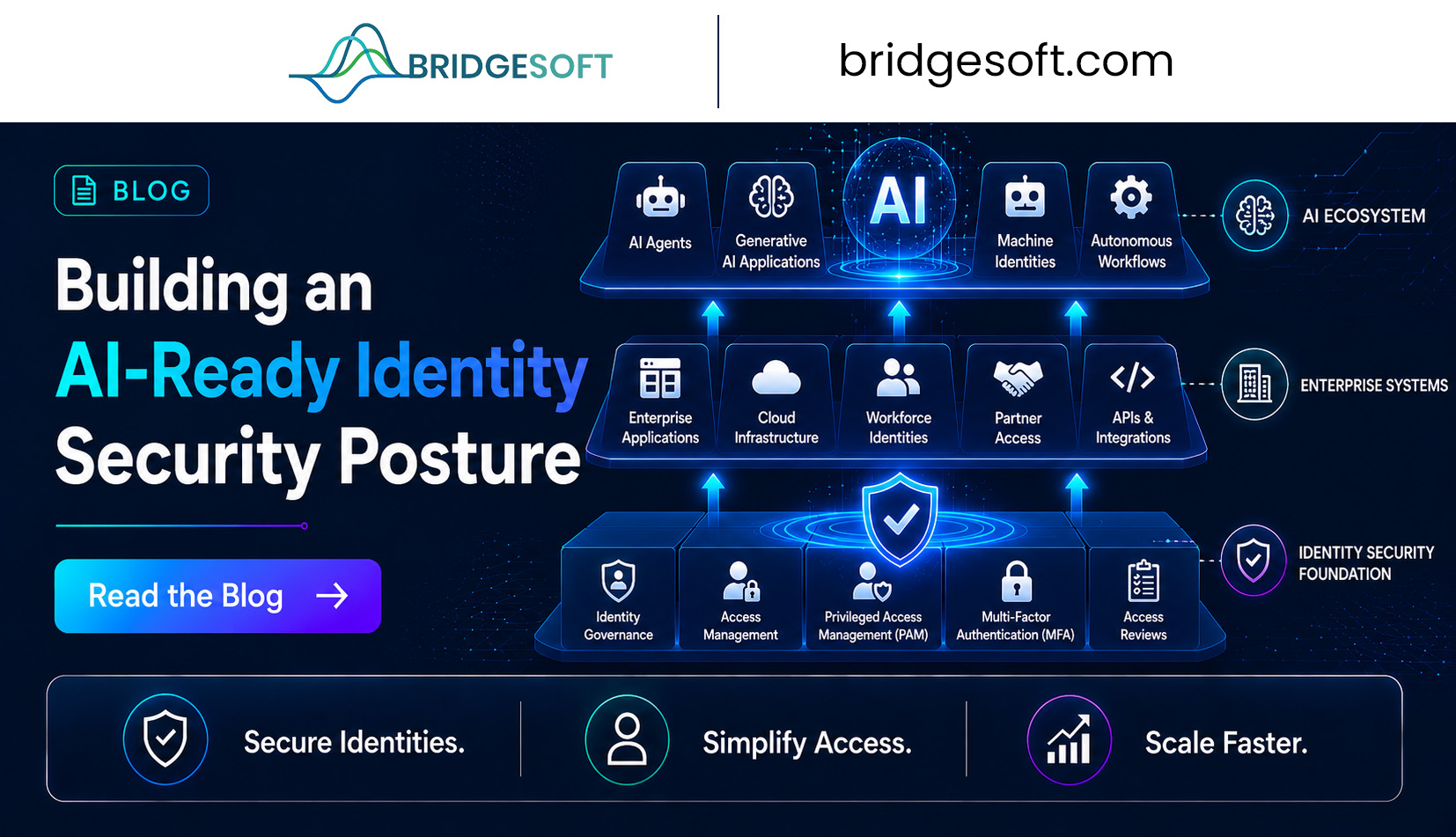
Artificial Intelligence is now central to modern business, driving intelligent automation, analytics, and customer experiences as organizations integrate it throughout their digital transformation.
However, as enterprises embrace AI, a critical question emerges:
Is your identity security strategy ready for AI?
While organizations invest in AI, many still struggle with identity-related risks and fragmented access controls. AI systems need access to applications, data, cloud platforms, APIs, and processes. Without a strong foundation in identity, these technologies can introduce new vulnerabilities rather than deliver innovation.
Building an AI-ready identity security posture is now a business imperative. Organizations must ensure that all users and identities—including AI agents—are governed, monitored, and secured through a modern Identity Access Management framework.
The future of AI depends on the strength of identity security.
Why Identity Security Matters More in the Age of AI
Employee access to business apps was the main emphasis of identity management in older IT systems. Today, the identity landscape is far more complex.
Organizations now manage thousands of identities across cloud, SaaS apps, APIs, automation tools, and AI-powered systems, each requiring access to data and resources.
This presents important security considerations.
If an AI model has excessive privileges, accesses sensitive data unchecked, or uses compromised credentials, the risks are significant. Protecting only people is no longer enough—digital entities require security as well.
Identity becomes the first line of defense in safeguarding vital company assets as AI adoption accelerates.
The Growing IAM Challenges in AI-Driven Environments
Many organizations are already facing significant IAM Challenges as they expand their digital ecosystems.
Disconnected identity repositories, inconsistent access policies, manual provisioning processes, and limited visibility often create security gaps that are difficult to manage. Introducing AI into this environment can magnify these issues.
Organizations frequently struggle to answer questions such as:
Without centralized identity controls, AI initiatives can increase operational complexity and expose organizations to compliance and security risks.
Addressing these IAM Challenges requires organizations to rethink identity security as a strategic business function rather than simply an IT process.
Identity Access Management: The Foundation of AI Security
A strong Identity Access Management strategy serves as the backbone of an AI-ready security posture.
Modern IAM solutions provide organizations with centralized control over users, applications, devices, APIs, and machine identities. By establishing consistent access policies across the enterprise, organizations can ensure that only authorized entities gain access to critical systems and sensitive information.
Identity Access Management enables organizations to:
As AI systems become more deeply integrated into business operations, Identity Access Management provides the governance framework needed to maintain trust, security, and accountability.
Without a strong foundation in identity, AI adoption can quickly outpace security controls.
Strengthening Cloud IAM Security for AI Applications
Most modern AI workloads operate in cloud environments. Whether organizations are deploying AI models, consuming AI services, or integrating cloud-based automation platforms, securing identities in the cloud has become essential.
This is where Cloud IAM Security plays a critical role.
Cloud IAM Security ensures that access controls remain consistent across cloud applications, infrastructure, and services. It enables organizations to manage identities centrally while maintaining visibility into who is accessing resources and why.
For AI-driven environments, Cloud IAM Security helps organizations:
As cloud adoption continues to accelerate, identity security becomes the primary mechanism for protecting AI-powered business operations.
Organizations that invest in strong Cloud IAM Security capabilities are better positioned to scale AI initiatives without compromising security.
Building Security into IAM Deployment
Many organizations view identity projects as technology implementations. But building an AI-ready security posture requires a strategic, forward-looking approach to IAM deployment.
A successful IAM strategy must address current needs and prepare for future AI-driven workloads.
This means designing identity architectures that can support:
Focus on automation, scalability, and governance from the start. Integrate access controls into AI workflows rather than adding them later.
By incorporating security into IAM Deployment strategies, organizations can establish a foundation that supports innovation while minimizing risk.
Enabling Digital Transformation Security Through Identity
AI is frequently seen as a driving force behind digital change. However, successful transformation requires more than deploying new technologies—it requires securing them.