Identity and Access Management (IAM) is no longer just a layer of security—it has evolved into a critical business enabler. From onboarding employees efficiently to ensuring regulatory compliance and enabling secure digital transformation, IAM sits at the heart of modern enterprise operations.
Despite its importance, many organizations struggle with a persistent, often underestimated challenge: slow IAM deployment.
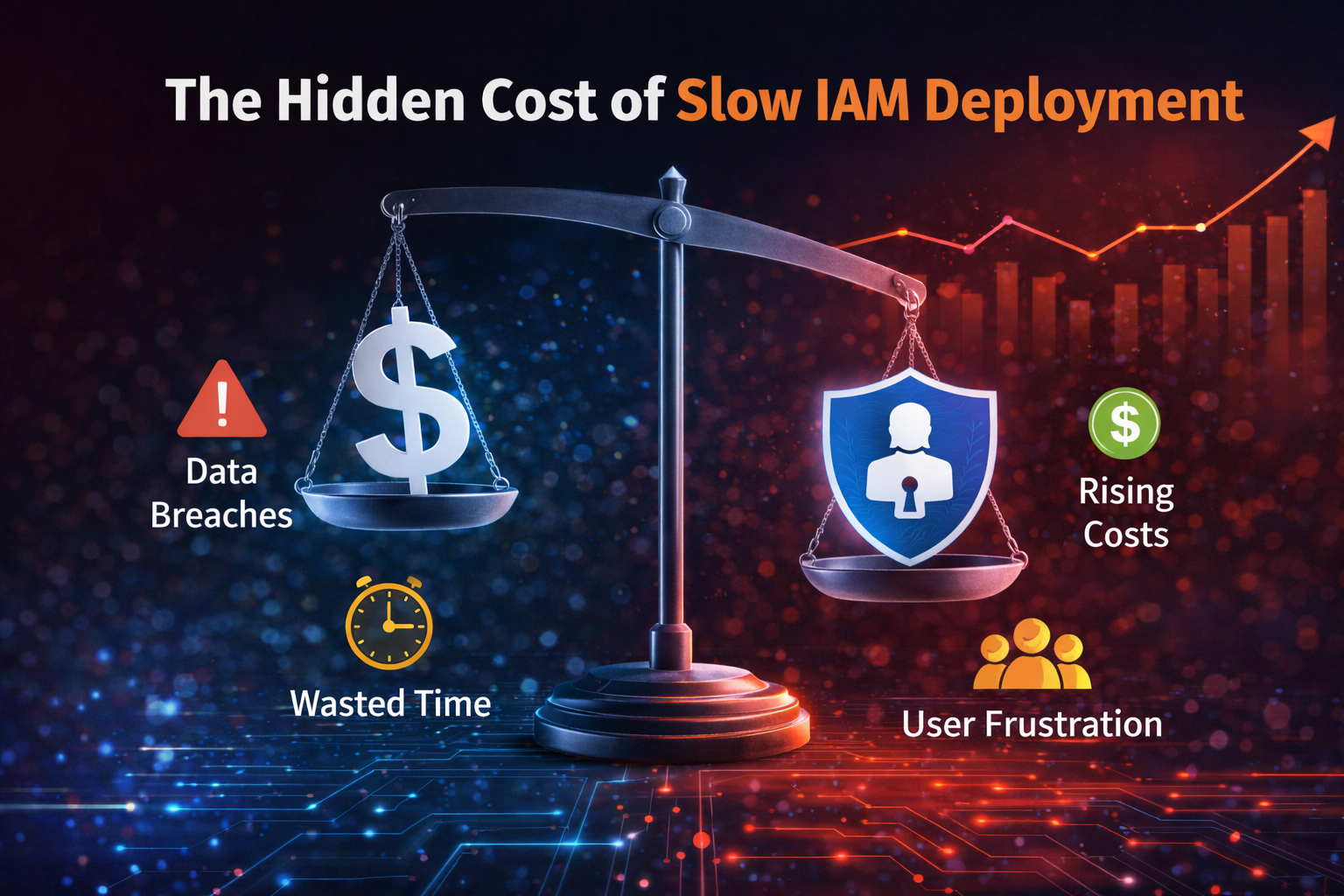
At first glance, implementation delays may appear manageable—just a few weeks added to timelines or minor integration setbacks. However, as these delays accumulate, they begin to create ripple effects across the organization. What starts as a technical delay gradually becomes a business problem, affecting security, productivity, compliance, and overall performance.
To truly understand how to avoid these outcomes, it’s important to first recognize the root causes behind why IAM Projects fail and how organizations can implement IAM successfully with the right strategy.
Slow IAM deployment is not just about missed deadlines—it often reflects deeper inefficiencies in an organization’s technology and processes.
It can manifest in several ways: delayed employee onboarding, prolonged application integrations, heavy reliance on manual provisioning, and extended implementation cycles that far exceed initial expectations. These inefficiencies are typically rooted in legacy systems, a lack of integration planning, and the absence of a structured implementation roadmap.
Organizations that take the time to build a clear IAM roadmap and prioritize early integration are better positioned to avoid these delays and achieve a more streamlined implementation journey.
One of the most immediate and critical consequences of slow IAM deployment is the increased exposure to security risks. When IAM systems are only partially implemented, users often retain access privileges longer than necessary, and manual errors become more frequent.
Delayed deprovisioning and lack of centralized control create gaps that can be exploited, increasing the likelihood of unauthorized access or data breaches. Over time, these vulnerabilities can have serious financial and reputational consequences for the organization.
Beyond security, slow IAM directly impacts the day-to-day productivity of employees and teams. When access to applications and systems is delayed, employees are unable to perform their roles efficiently.
IT teams, on the other hand, are often burdened with repetitive manual tasks such as provisioning and access approvals. This not only slows down business workflows but also diverts valuable resources away from more strategic initiatives.
The result is a workplace environment where inefficiencies become normalized, and both employees and IT teams experience growing frustration.
IAM is often viewed as a long-term investment in security and efficiency. However, when deployment is slow, it begins to behave more like an ongoing operational expense.
Delays lead to extended development efforts, continuous rework, and increased reliance on manual processes. Organizations may find themselves allocating additional resources to maintain incomplete systems, driving up costs without delivering proportional value.
In such scenarios, the true cost of IAM is not in its implementation—but in its delay.
IAM plays a central role in maintaining regulatory compliance and ensuring audit readiness. When implementation is delayed, organizations struggle to establish complete audit trails, enforce access governance policies, and generate consistent reports.
These gaps can lead to compliance failures, especially in highly regulated industries where visibility and accountability are critical. The longer the IAM deployment is delayed, the more difficult it becomes to meet regulatory requirements and avoid potential penalties.
IAM is a foundational component for broader digital transformation efforts, including cloud adoption, automation, and Zero Trust security models.
When IAM deployment is slow, it creates a bottleneck that impacts these initiatives. Organizations may find themselves unable to move forward with modernization efforts because the underlying identity infrastructure is not yet mature.
In this way, IAM delays do not just affect security—they slow down the organization’s ability to innovate and compete in a digital-first world.
In today’s fast-paced work environment, users expect seamless and immediate access to the tools they need. Slow IAM processes, however, often lead to login issues, access delays, and inconsistent user experiences.
When employees are unable to access systems efficiently, they may turn to unauthorized tools or workarounds—leading to the rise of shadow IT. This not only undermines security but also creates additional governance challenges for the organization.
A major contributor to slow IAM deployment is the difficulty of integrating with legacy systems. Many enterprises operate with outdated platforms that lack modern APIs or standardized integration capabilities.
As cloud adoption continues to accelerate, identity has become one of the most critical and complex components of enterprise security. Organizations are no longer relying on a single cloud provider or data center; instead, they are operating in multi-cloud and hybrid environments that span public clouds, on-premises systems, SaaS platforms, and legacy infrastructure.
This fragmented landscape presents a growing challenge: how to manage identity consistently across a diverse, dynamic IT ecosystem. It’s not just about keeping users connected it’s about keeping access secure, compliant, and scalable without slowing down innovation.
Solving this challenge starts with a shift in mindset: identity must be viewed not as a one-time project, but as a foundational architecture layer one that underpins access, governance, and risk across every platform the business touches.
The move to cloud is rarely all-or-nothing. Many organizations adopt cloud services incrementally, driven by specific business needs. A company might use AWS for development, Azure for Office 365, and Google Cloud for data analytics all while retaining core legacy systems on-premises due to regulatory or operational constraints.
This flexibility comes at a cost. Each environment may have its own identity model, access controls, and integration capabilities. Without a unified strategy, this leads to identity silos: users with duplicate accounts across systems, inconsistent roles and entitlements, and gaps in visibility. These silos increase risk, reduce efficiency, and make compliance audits far more difficult.
Additionally, the growing number of non-human identities such as service accounts, bots, and machine workloads adds complexity. These identities often lack proper governance, creating blind spots and potential entry points for attackers.
Traditional IAM solutions were built for centralized environments, where users and resources were confined to a corporate domain. In today’s distributed architecture, this model breaks down. Manual provisioning, static policies, and point-to-point integrations simply cannot keep pace with the velocity and scale of modern cloud environments.
When identity is managed in silos, the business suffers:
To address these challenges, organizations must adopt a cloud-ready identity architecture one that is unified, automated, and policy-driven.
Building an identity strategy that spans cloud and on-premises systems requires several key capabilities:
A strong, cloud-ready identity strategy is key to secure, compliant, and scalable operations.
See how Bridgesoft can unify and automate identity across your cloud and on-premises systems: Bridgesoft Identity Solutions
Imagine your phone, computer, or favorite app being compromised, wouldn’t you want an immediate solution?
Well, lucky for you, there is one! There’s a digital detective whose job is to figure out who did it, how they did it, and what they accessed. That’s what Cyber Forensics is all about, solving digital crimes by collecting and analyzing evidence from electronic devices.
Now, here’s where IAM, short for Identity and Access Management, becomes a hero:
IAM is like the bouncer at a VIP party. It decides who gets in, what rooms they can enter, and what they’re allowed to do. And when something goes wrong, IAM keeps a record of every door opened and by whom. Think of it as having a detailed guest list and security footage at every door.
This makes Cyber Forensics faster and more accurate because investigators can trace digital footprints back to specific users or actions. Meaning that we are able to let you rest, knowing that you’re safe.
So in today’s world of constant digital threats, IAM isn’t just about security. Let’s imagine a scenario together so that you will know what to do in a situation where Cyber Forensics is needed. Because IAM is also about catching criminals.
You have just received an email from our cybersecurity team, telling you and the team to be cautious in opening suspicious emails or answering any call that requests us to log in to the link(s) that they provide.
Everyone began to question what was happening and found that there was a threat actor (TA) attempting to impersonate an IT support personnel, asking employees to log in to a link in order to get their user ID and password, also known as a user's login credentials.
The TA can use the login of whoever falls for the trick and get confidential company information. We were all relieved to find that our identity and access management (IAM) security awareness program was able to save the company from the cyber attack.
So, what exactly happened? The TA was able to convince one employee to create a login, hence getting access to their credentials. The TA then tried to log in to our company’s application from his device, in which he was prompted to use two-factor authentication.
The user was told to give him the authentication code which raised a red flag. It is
known that people are not meant to share the code with anybody especially for something important. The user immediately hung up and reported the incident to our security team…
This is known as an outsider threat, which happens when a person outside of a secure system manages to get in and essentially steal, change or block access to data.
However, companies must also be wary of the people on the inside, individuals within the system who misuse their access. IAM systems enhance digital forensics by monitoring user access, enforce stricter controls, and strengthen security overall.
IAM and Cyber Forensics play hand in hand together, and with this example above, it’s clear it’s more common than we think.
Every time you log into your email, swipe your access card at work, or even unlock your phone with Face ID, IAM is quietly working in the background. It’s making sure you are really you, and that you’re only accessing what you’re supposed to.
But when something goes wrong, like a data breach or unauthorized access, Cyber Forensics steps in. And thanks to IAM logs and records, investigators can follow the digital breadcrumb trail. They can pinpoint who accessed what, when, from where, and even what device they used.
This partnership is crucial, especially today when cybercrimes are becoming more sophisticated. Without IAM, forensic experts would be digging through a digital haystack without a clue. But with IAM? It’s like turning on the lights in a dark room.
Together, IAM and Cyber Forensics don’t just help respond to attacks, they help prevent them, by tightening access controls and spotting unusual behavior before it becomes a bigger problem.
So the next time you log in somewhere or get asked to verify your identity, remember: that tiny inconvenience is actually part of a much bigger system working to keep you, and your data safe.
In the dynamic realm of modern business operations, cloud computing's transformative potential is accompanied by the intricate challenge of managing identities. This article explores the complexities arising from cloud environments, spotlighting the critical role of identity control in navigating this digital landscape.
Amidst the myriad benefits of cloud adoption, the need for strategic solutions becomes evident. Effective identity governance emerges as the linchpin for businesses seeking resilience in the face of cloud complexity, underscoring the importance of a cohesive approach to identity management.
Grasping Cloud's Complexity
As businesses gravitate towards cloud infrastructures, the beauty of flexibility also brings in a layer of intricacy. The array of cloud services, coupled with hybrid and multi-cloud setups, amplifies the complexity. In this digital evolution, ensuring seamless and secure access has become a puzzle we need to solve.
Essence of Identity Control
At the heart of it, identity control revolves around safeguarding critical assets by managing user access and permissions. In the cloud landscape, where traditional boundaries vanish, identity becomes the cornerstone. Effectively managing identities is the key to preserving the confidentiality, integrity, and availability of data.
Challenges in Managing Cloud Identities
1. Dynamic Workloads
Cloud environments are dynamic, allowing workloads to pirouette from one corner to another. Traditional identity management struggles to keep up, potentially leaving gaps in access control and compliance.
2. Integration Tango Across Platforms
Hybrid and multi-cloud setups demand a coordinated dance across platforms. The challenge lies in orchestrating identity management tools seamlessly to maintain a unified approach without compromising on security.
3. The Art of Granular Access
Growing organizations need granular control. Assigning and revoking permissions at a fine-grained level demands a precision that traditional identity management finds a bit challenging.
4. The Compliance Jazz
Regulatory compliance is non-negotiable. Yet, the dynamic cloud environment demands continuous monitoring and real-time adjustments, a task that traditional solutions often find like playing a musical instrument without the right notes.
Navigating with Identity Governance Solutions
1. Monitoring Real-Time
Identity governance solutions with robust analytics offer a front-row seat to user activities across cloud platforms. This real-time visibility lets organizations spot potential security threats before they take center stage.
2. Harmony in Identity Orchestration
Advanced identity governance solutions can orchestrate identity management across diverse cloud platforms. This harmonious approach streamlines administrative efforts, ensuring consistent control and adherence to security policies.
3. Role-Playing for Security
Implementing Role-Based Access Control (RBAC) within identity governance frameworks addresses the challenge of granular access. Associating roles with specific permissions allows organizations to keep the security dance in rhythm with operational efficiency.
4. Automating the Compliance Waltz
Identity governance solutions automate compliance management, offering continuous monitoring and instant responses to deviations from regulatory requirements. This not only ensures adherence but also reduces the burden on compliance teams, making the compliance dance a bit more effortless.
Finding the Path Forward
In the maze of cloud complexity, organizations can find solace in advanced identity governance solutions. As the digital landscape evolves, investing in a strategic identity control framework becomes a proactive measure to mitigate risks and ensure a resilient security posture.
In conclusion, the dance between cloud complexity and identity control presents both challenges and opportunities. Embracing advanced identity governance solutions empowers organizations to not only navigate these challenges but also waltz through the full potential of cloud technologies securely. As the digital transformation unfolds, the role of identity governance emerges as the guiding partner for sustainable and secure cloud operations.
As your organization navigates the complexities of cloud computing and identity management, consider partnering with Bridgesoft for comprehensive solutions. Our expertise in identity governance empowers businesses to streamline operations, enhance security, and ensure regulatory compliance in the cloud. Contact us today to embark on your journey towards a resilient and secure digital future.
As organizations increasingly embrace cloud environments for their operations, the intricacies of managing identity governance have become more pronounced. The delicate balance between providing a seamless user experience (UX) and maintaining robust security measures is at the forefront of challenges faced by businesses in their quest for efficient and secure cloud-based identity governance systems. In this comprehensive article, we will delve into the multifaceted dimensions of this challenge, exploring the intricacies, strategies, and implications for organizations seeking to strike the optimal equilibrium.
Cloud identity governance encompasses the policies, processes, and technologies that organizations employ to ensure the secure and efficient management of user identities and access within cloud environments. The complexity arises from the need to provide users with a positive and seamless experience while simultaneously implementing stringent security measures to protect sensitive data and maintain regulatory compliance.
The User Experience Imperative
A positive user experience is not only desirable but fundamental to the success of any identity governance system. In the context of the cloud, where accessibility and usability are paramount, several factors contribute to the user experience imperative:
The Security Imperative
While a positive user experience is essential, the core objective of any identity governance system is to ensure robust security. Balancing user experience with security imperatives involves implementing measures that safeguard sensitive data:
Strategies for Harmony
Achieving harmony between user experience and security in cloud identity governance requires a multifaceted approach. Several strategies can be employed to navigate this delicate balance:
Conclusion
In navigating the intricate landscape of cloud identity governance, organizations must recognize the delicate interplay between user experience and security imperatives. Striking the right balance requires a holistic approach that leverages innovative technologies, embraces user-centric design principles, and implements adaptive security strategies. By carefully orchestrating these elements, organizations can create a cloud identity governance system that not only meets security standards but also enhances the overall user experience. In doing so, they contribute to a secure, efficient, and user-friendly digital ecosystem that aligns with the evolving needs of modern enterprises in the cloud era.
In the dynamic landscape of cloud identity governance, Bridgesoft emerges as your trusted ally. Elevate your security measures and redefine user experiences with our innovative solutions. Explore the limitless possibilities that Bridgesoft brings to the future of identity governance. Secure, seamless, and ahead of the curve — that's the Bridgesoft advantage.
In today's digital age, the adoption of cloud computing has become increasingly prevalent among organizations of all sizes. As more data is being stored and processed in the cloud, security has become a top concern for businesses. One of the most critical components of cloud security is identity access management (IAM), which is the practice of controlling and monitoring user access to an organization's systems and data. In this article, we'll explore the importance of building a strong IAM strategy for cloud environments and provide some tips and best practices to help you get started.
The Challenges of IAM in Cloud Environments
When it comes to managing user identities and access in cloud environments, there are a few unique challenges that organizations face. First, because cloud environments are dynamic and often involve multiple service providers, it can be challenging to keep track of who has access to what data and resources. Additionally, cloud environments are highly scalable and can expand or contract rapidly, which means that IAM solutions need to be able to adapt quickly to these changes.
Another challenge is that cloud environment often involve multiple layers of security, including firewalls, virtual private networks (VPNs), and access control lists (ACLs). Managing these different security mechanisms can be complex and time-consuming, particularly if they are not integrated with IAM solutions.
Finally, cloud environments can also be susceptible to insider threats, where employees or contractors with legitimate access to systems and data intentionally or unintentionally misuse their privileges. Managing these insider threats requires a holistic IAM approach that includes role-based access controls, user behavior analytics, and regular security training for employees.
Key Elements of a Strong IAM Strategy for Cloud Environments
To build a strong IAM strategy for cloud environments, there are several key elements to consider. These include:
Best Practices for Implementing IAM in Cloud Environments
Implementing IAM in cloud environments requires a different approach than traditional on-premise environments. As more organizations move to the cloud, it is important to understand the unique challenges and best practices associated with implementing IAM in this environment. By following best practices such as defining IAM requirements, using multi-factor authentication, implementing RBAC, monitoring and auditing access, and implementing JITP, organizations can develop a robust IAM program that protects their cloud resources from unauthorized access and data breaches.
Additionally, organizations must understand the shared responsibility model in cloud environments. While cloud service providers are responsible for securing the cloud infrastructure, customers are responsible for securing access to their own resources in the cloud. By implementing effective IAM controls, organizations can meet their responsibility to secure access to their cloud resources and protect sensitive data from potential security threats.
To wrap up, a strong identity access management (IAM) strategy is critical to securing access to cloud resources and protecting sensitive data. It requires a thorough understanding of the unique challenges and considerations involved in implementing IAM in cloud environments, as well as adherence to best practices such as defining IAM requirements, implementing multi-factor authentication and role-based access control, monitoring and auditing access, and just-in-time provisioning. By following these best practices and regularly assessing and updating IAM controls, organizations can effectively manage access to their cloud resources and reduce the risk of security breaches and data loss.
Secure your cloud resources with a strong IAM strategy. Learn how to build and implement effective IAM controls in cloud environments today. Contact us to explore more.
With the advent of digital transformation, businesses across the globe have scaled up to new heights. Every organization has its own set of business functions, with dedicated teams operating on them and generating huge piles of files. Large teams working with loads of data can lead to numerous confusions about who needs access to which data/files.
In addition, security concerns are not new for businesses when it comes to handling sensitive data. Intentionally or not, unintended access to corporate data by an employee can turn up into data loss or leak which is detrimental to the business.
In this digital era, data is a prime asset for businesses. Therefore, it is of high priority to maintain its integrity. All of these pave the path for an identity and access management solution that helps organizations manage user access to IT assets.
What is IAM?
Identity and Access Management (IAM) focuses on ensuring that access to key business data is provided to the right resources while remaining inaccessible to others. According to Gartner, “IAM enables the right access to the information, for the right people, for the right reasons, and at the right time."
The Many Benefits of IAM
IAM undoubtedly is beneficial for organizations. Here are some areas where IAM can bring a positive change:
#1 Reduced Risk
IAM gives you more user control, which means your organization becomes less prone to internal and external data theft. In the event of hacking, where typically hackers use the user credentials to gain access to the key resources and networks, it is important.
#2 Enables Highly Secure Access
With the expansion of your business, new employees, third parties, and customers keep on adding up which in turn increases your risk. IAM solutions help you expand your business operations without worrying about security.
#3 Helps You Stay Compliant
A well-designed IAM solution can help your company fulfill its compliance needs while helping you stay updated with the changing data security regulations.
#4 Largely Reduces Helpdesk Tickets
IAM finds the user’s requirements and accordingly resets the credentials and the support team will help to automate the same. To get authentication, the user should verify their identity first which reduces the burden on the administrator and helps them focus on the other priority tasks.
#5 Reduced IT Costs
Identity and access management helps reduce operational costs. With federated identity access management, you can simply eliminate the local identities required for external users which in turn make the administration of the application a lot easier. The cloud IAM solutions eliminate the need for on premise infrastructure, reducing maintenance costs.
In addition to the aforementioned benefits, the IAM framework gives an edge to businesses over their competitors. Identity and access management provides key data access to the external users without jeopardizing security and helps them perform their tasks effortlessly.
The benefits mentioned here—are just the tip of an iceberg; IAM comes with many benefits for your organization. If you are planning to implement an identity and access management solution in your organization, please feel free to get in touch with us. Bridgesoft, bringing a pioneer in the IAM arena helps you sail smoothly through the processes and customize the identities across your resources.
Bringing New Life to Identity and Access Management In our current digital world, safety matters, and so does speed. Identity and Access Management (IAM) has become important.
Bridgesoft is leading in the IAM realm, giving special attention to Identity Governance and Administration (IGA).
Bridgesoft Identity Gateway is an amazing tool. This connects Identity Providers (IDPs) with apps. It's great for older systems that may not use modern protocols like SAML or OIDC.
Speed up App Integration: Adding new applications to the IAM landscape can now be done faster and easier.
Boost Security: Enforce strong authentication and keep out unwanted access.
Smooth IAM Processes: Automate everyday tasks, improving operations. A Band of IAM Gurus A crew of capable identity engineers drives Bridgesoft's triumph.
These pros, with deep IAM know how, deliver customized solutions for each organization.
Cutting-Edge Tech: Bridgesoft uses the hottest tech available to deliver IAM solutions that are good to grow and can be trusted.
Deep Industry Insight: Bridgesoft knows the rules and helps organizations navigate IAM.
Customer Centric Attitude: Focused on building lasting friendships with clients, ensuring top-notch help and service.
Upgrade Old Systems: Improve security.
Simplify IAM Tasks: Automate efforts, lessen errors. Boost User Experience: Deliver a simple and safe user journey.
Strengthen Security: Keep important data safe and reduce chances of risks.
Achieve Consistency: Meet industry standards.
The Next Generation of IAM, As our digital arena grows and changes, the need for solid IAM solutions will go up. Bridgesoft is geared up and ready to take on these hurdles. By backing change, maintaining strong bonds, and offering top solutions, they are committed to help organizations achieve IAM victory.
Ending Note Bridgesoft's out-of-the box approach to IAM, together with their team of gurus, enables organizations to modernize their IAM landscapes, beef up security, and streamline tasks. If you want to level up your IAM game, think about teaming up with Bridgesoft.
Contact us today to learn more about how Bridgesoft can help you achieve your IAM goals