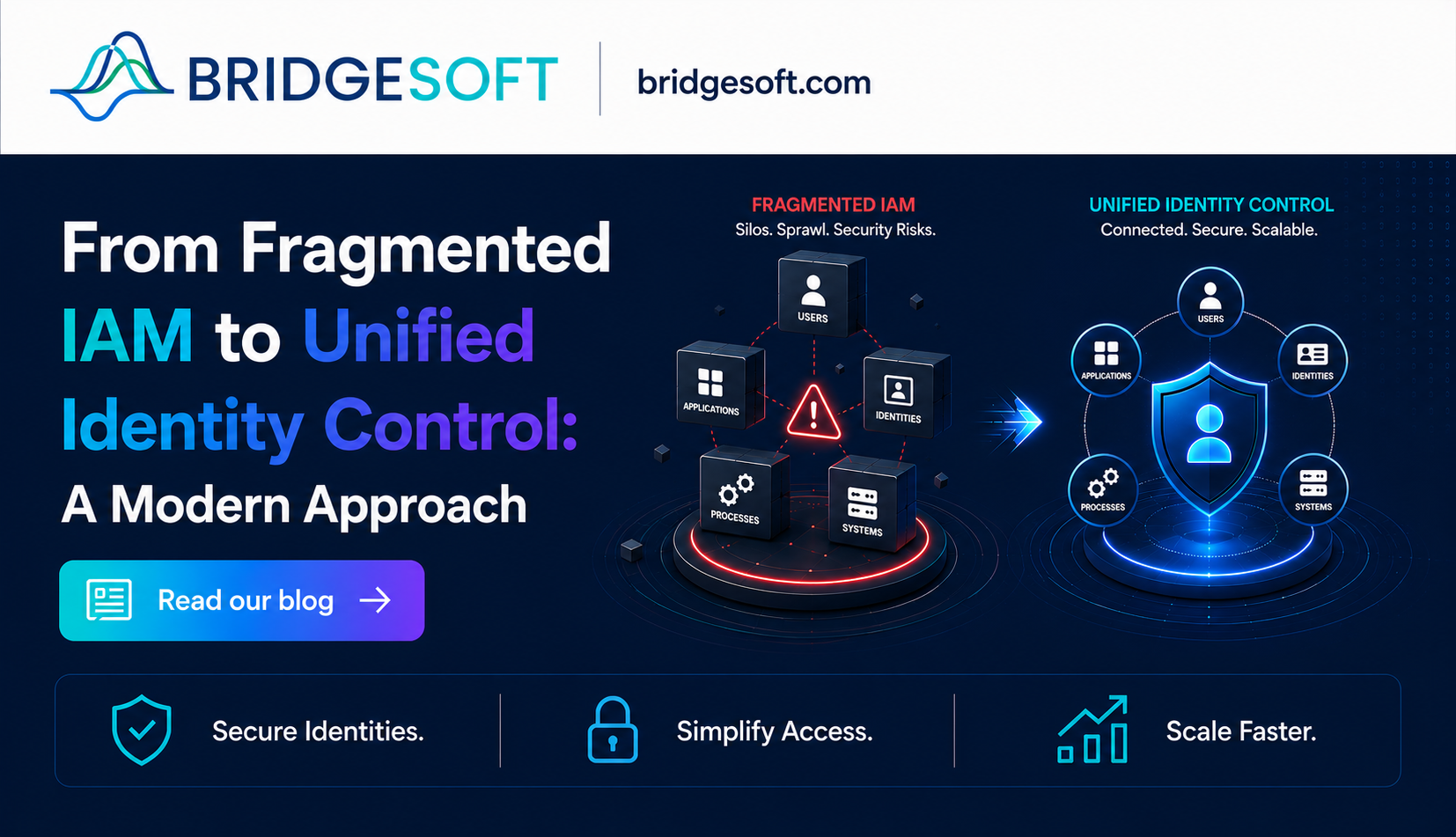
Organizations today operate in highly connected digital environments where employees, applications, and data exist across cloud, on-premises, and hybrid infrastructures. While businesses continue to accelerate their digital transformation, many still struggle with fragmented systems that create security gaps, operational inefficiencies, and inconsistent access controls.
Disconnected platforms and manual access process’s complicate identity management. Employees juggle multiple credentials, and IT teams spend excessive time resolving access issues. These systems decrease productivity and heighten the risks of unauthorized access and compliance failures.
Organizations are moving toward unified identity control—a centralized approach that strengthens security and streamlines access management. Modern IAM solutions create connected ecosystems with improved visibility, governance, and operational efficiency.
Fragmented IAM grows as organizations add technologies, expand operations, acquire new businesses, merge with other entities, or integrate multiple systems—without a centralized identity strategy. Large enterprises with multiple subsidiaries or business units often inherit disconnected identity environments that become increasingly difficult to manage and secure over time.
Without Identity Governance, organizations risk excessive privileges, orphaned accounts, delayed deprovisioning, and inconsistent access policies. These gaps expose systems and data, creating compliance headaches during audits.
In addition, scattered access information makes it difficult for security teams to gain complete visibility into who has access to critical resources and whether those permissions remain appropriate. Modern enterprises require more than isolated identity tools — they need centralized identity intelligence to secure the entire digital ecosystem.
[The Future of Identity Governance]
A unified IAM approach turns identity into a strategic advantage by centralizing authentication, access management, and user governance. Unified Identity and Access Management delivers stronger security, smoother operations, and more consistent controls across the enterprise.
Modern IAM platforms support advanced security capabilities such as Single Sign-On (SSO), Multi-Factor Authentication (MFA), and adaptive authentication. These technologies help employees securely access applications without the complexity of managing multiple credentials. At the same time, organizations strengthen protection against unauthorized access attempts and identity-based cyber threats.
Unified identity systems automate access tasks and centralize operations on a single platform, reducing IT complexity and supporting seamless user experiences across cloud and hybrid environments.
Identity is the new security perimeter. Organizations must monitor access requests, permissions, and identity-related activity to reduce risk and stay compliant. Identity Governance is essential.
Modern governance solutions give visibility into user access across systems. Businesses automate reviews, enforce policies, and monitor activities to spot risky behavior or excessive permissions.
By integrating Identity Governance into a centralized IAM framework, organizations can significantly reduce insider threats, improve compliance readiness, and ensure that users maintain only the access necessary for their roles. Automated audit reporting and policy enforcement also simplify compliance management for regulations such as GDPR, HIPAA, and ISO standards.
Manual identity management causes delays, inconsistencies, and security gaps. Modern IAM platforms automate user access provisioning to fix this.
Intelligent workflows let organizations automatically create accounts, assign permissions, and grant role-based access. When roles change or employees leave, permissions are updated or revoked immediately.
Automated user access provisioning improves operational efficiency while reducing the risks associated with dormant accounts, overprovisioned access, and manual errors. It also enhances employee productivity by enabling faster, more secure access to business-critical applications.
As organizations adopt cloud, remote work, and SaaS applications, digital transformation security becomes a top priority. Modern IAM Solutions provide the scale and flexibility required to secure rapidly evolving environments.
Centralizing identity controls enables consistent security across the enterprise. Adaptive authentication and AI-driven threat detection respond dynamically to changing risk levels and user behaviors.
Unified platforms also accelerate innovation by simplifying integration with digital services, allowing organizations to extend IAM policies consistently across the organization.
Final Thoughts:
Fragmented identity systems add complexity, inefficiency, and security risks that businesses can no longer ignore. Unified IAM centralizes control, strengthens governance, improves secure access management, and automates provisioning.